
Key Summary
Buried-suture surgery holds a crease with sutures, while incisional surgery opens the skin to address fat and excess skin. Crease loss is a main concern with buried sutures; prolonged swelling and incision scars are concerns with incision. The decision follows an examination of thickness, sagging and eyelid-opening function, including any previous crease loss.
How do buried-suture and incisional double-eyelid surgery differ?
Buried-suture surgery fixes a crease without a skin incision; incisional surgery opens the eyelid skin, addresses tissue and fat, then fixes the crease. Asan Medical Center describes buried sutures mainly for younger people with thin eyelids and little fat. Its incision guidance includes removal of some skin and muscle, and fat when needed, with a possible scar along the incision.
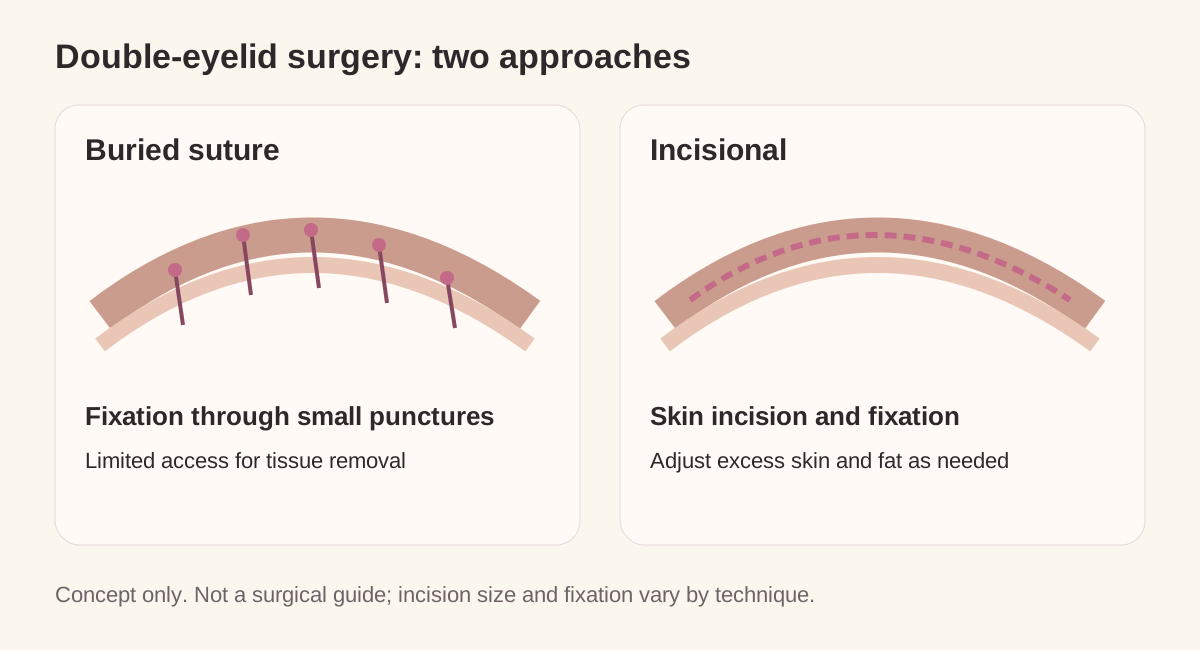
| Comparison | Buried sutures | Incision |
|---|---|---|
| Skin opening | Small punctures rather than a skin incision | Incision along the planned crease |
| Fat and skin | Access through punctures is limited; added fat removal varies by clinic | Fat and excess skin addressed when needed |
| Suture removal | Buried sutures remain inside; removal of any skin sutures depends on technique | Removed on the clinic's schedule |
| Scars | Small puncture sites | Incision within the crease; clinic guidance describes color fading over 3–6 months |
These are the published explanations of JK Plastic Surgery Clinic, The Swan Plastic Surgery Clinic and Asan Medical Center.
Where do partial incision and natural adhesion fit?
Partial incision uses several short openings to address some fat and tissue; their size and number differ between clinics. The Swan Plastic Surgery Clinic describes intermediate crease retention and settling around 2 months.
| Clinic | Published partial-incision approach |
|---|---|
| 1 Percent Plastic Surgery Clinic | A 7–8 mm linear incision with additional point openings |
| JK Plastic Surgery Clinic | Two or three openings of about 3–4 mm; suture removal on day 4 |
| Mine Plastic Surgery Clinic | Minimal incisions at 5–7 sites |
The Swan places natural adhesion within the buried-suture family and describes reducing crease loss as its goal. The same clinic's director also calls it intermediate between buried sutures and incision. An identical procedure name does not establish an identical technique.
How often does a buried-suture crease loosen?
A buried-suture crease can loosen and require another operation. Research counts crease fading or disappearance, revision specifically for crease loss, and suture removal because of an unwanted shape as different outcomes.
| Finding | Source and population |
|---|---|
| Crease loosening described in no more than 5% of patients | Asan Medical Center patient information |
| Revision for crease loss: 22.3%; under age 20, 41%; ages 30–39, 12% | Retrospective two-point buried-suture cohort, 600 cases with 100 per age group |
| Revision: 17.0% with fat removal versus 33.5% without | Retrospective comparison, 188 in each group, about 4.5 years |
| Lower revision risk for crease loss with continuous fixation | Fixation-technique comparison, 513 patients |
| Better crease retention with conjunctival than skin-side fixation | Transcutaneous versus conjunctival fixation, 423 eyelids |
The techniques, patients and observation periods differ. No single number in this table is the probability of crease loss for every buried-suture operation. Revision study, fat removal and crease retention
Among 1,198 postoperative reviews, 157 (13%) mentioned loosening or another operation after loosening. Of the 78 that named the earlier operation, 62 (79%) described buried sutures, 11 incision and 5 partial incision. Of 47 giving a time to loss, 35 described more than 3 years. These accounts include revision patients, and the wider review dataset also contains more buried-suture posts. The numbers do not measure the proportion of all operated patients whose crease loosened.
Does an incisional crease never loosen?
Incisional creases also loosen; individual studies report partial loss around 2%. Neither clinic wording nor reviews establish a guarantee against crease loss.
| Finding | Study |
|---|---|
| Partial loss in 86 patients (2.1%), asymmetry in 230 (5.6%), depressed scars in 5 | Incision-based fixation, 4,129 patients, median follow-up 12 months |
| Partial loss in 14, complete loss in 4, hypertrophic scars in 7, asymmetry in 8; satisfaction 95% | Korean incision study, 680 patients, mean follow-up 3.6 years |
| About 5% complications and 2% crease loss in each of the single-incision and three-incision groups | Pooled results for those two techniques within a 13-study, 4,177-patient small-incision review |
| Higher satisfaction and fewer complications at 6 months and 5 years in the small-incision group; no difference in permanence | Small versus full incision, 333 patients |
These studies used different techniques and patient groups. Comparing their rates with buried-suture revision rates does not calculate how many times safer one operation is. Among 9 review statements comparing crease loss, 7 favored incision or partial incision. Incision-based fixation study, Korean incision study
The Swan Plastic Surgery Clinic describes relatively strong crease retention with incision, while noting that revision carries additional scarring risk.
How long do swelling and bruising last?
Among reviews giving a time for swelling to subside, 60% of buried-suture, 34% of incision and 46% of partial-incision accounts described 2 weeks or less. The timing groups contained 53, 29 and 48 reviews respectively.
| Reported time | Buried sutures | Incision | Partial incision |
|---|---|---|---|
| Within 3 days | 5 | 1 | 2 |
| 1 week | 14 | 5 | 8 |
| 2 weeks | 13 | 4 | 12 |
| 3–4 weeks | 8 | 9 | 17 |
| 1–2 months | 4 | 6 | 3 |
| 3 months or longer | 9 | 4 | 6 |
Of 56 statements directly comparing swelling or recovery, 42 favored buried sutures, 5 incision, 3 partial incision and 5 described no difference; 1 was unclear. Marked swelling appeared in 30 buried-suture reviews (8%), 27 incision reviews (7%) and 13 partial-incision reviews (3%). Bruising appeared in 47 (12%), 26 (7%) and 31 (8%). These percentages use all analyzed reviews for each method, not only posts mentioning swelling or bruising. Concurrent ptosis correction appeared in 47% of incision reviews, so operative scope also differed.
| Clinic | Buried sutures | Incision |
|---|---|---|
| Gangnam Seoyeon Plastic Surgery Clinic | Much early swelling subsides in 1–2 weeks | Longer swelling; include suture removal when planning time off |
| 1 Percent Plastic Surgery Clinic | Describes less swelling and bruising and faster recovery | Greater early swelling is possible |
| The Swan Plastic Surgery Clinic | Settling over 1–2 months | Settling over 2–3 months |
These are clinic explanations. Asan Medical Center gives about 1 week for ordinary activities and 2–3 months for the crease to settle, without separating the methods.
What do reviews say about scars and asymmetry?
Noticeable scars appeared in 18 incision reviews, 14 partial-incision reviews and 2 buried-suture reviews. Scarring was discussed in 36 buried-suture, 68 incision and 51 partial-incision reviews. Within those groups, 29, 48 and 34 described fading or no visible scar. Asymmetry appeared in 25 buried-suture reviews (6%), 29 incision reviews (7%) and 36 partial-incision reviews (9%), without a large difference in these review proportions.
A 7-year analysis of complaints following Asian blepharoplasty identified asymmetry as the most common complaint after both primary and repeat surgery, usually a difference in crease height. Asan Medical Center lists hematoma, outward or inward turning of the eyelid, dry eye and asymmetry among complications.
Do thick or sagging eyelids require incision?
Clinic guidance generally points toward incision or partial incision for thick, fatty or sagging lids, while reviews and research also describe buried sutures combined with fat removal.
| Clinic | Published buried-suture indications | Published incision indications |
|---|---|---|
| Gangnam Seoyeon Plastic Surgery Clinic | Thin skin, little sagging or fat, absent or hidden crease | Thick or sagging skin needing ptosis correction, more fat or marked asymmetry |
| 1 Percent Plastic Surgery Clinic | Thin lids, little fat, good eyelid-opening function | Thick lids, more fat, substantial sagging |
| JK Plastic Surgery Clinic | Thin lids with little fat | Sagging skin, thick fat, ptosis or marked asymmetry |
| Mine Plastic Surgery Clinic | Describes double-knot buried sutures as unsuitable for thick lids | Full incision for ptosis correction; partial incision for fatty lids |
These are the clinics' own criteria, not independently validated selection rules.
Thick or fatty eyelids appeared in 19 buried-suture reviews (5%), 46 incision reviews (12%) and 35 partial-incision reviews (9%). Sagging skin appeared in 15%, 18% and 14%. Eyelid condition was given as a reason for the method in 18 (4%), 34 (9%) and 3 (1%) respectively. The buried-suture study reporting revision at 17.0% with fat removal versus 33.5% without makes the handling of fat an important consultation question alongside the method's name.
Which methods were used in actual clinic cases?
Resum Plastic Surgery Clinic and Cheongdam Model Plastic Surgery Clinic publish cases organized by eyelid condition, including limitations of buried sutures. The following outcomes are the clinics' accounts, not independently verified results.
| Clinic | Starting condition | Procedure | Clinic-reported result and limitation |
|---|---|---|---|
| Resum Plastic Surgery Clinic | Early 20s, not thick and little sagging, but one-third of the iris covered | Buried sutures with non-incisional ptosis correction | Describes a natural in-out crease and no visible operative marks with eyes closed at 7 months |
| Resum Plastic Surgery Clinic | Not thick, but excess skin pressing on the lashes | Incision with excess-skin removal | Describes a natural-looking crease |
| Cheongdam Model Plastic Surgery Clinic | Mild sagging and habitual brow raising | Buried sutures | Describes lower brow position and improvement in the hollow-looking upper lid |
| Cheongdam Model Plastic Surgery Clinic | Previous buried sutures elsewhere had loosened; crease too large | Repeat buried sutures with non-incisional ptosis correction | Explains the aim of reducing loosening; no follow-up duration or retention rate supplied for this case |
Resum published its cases in April 2022. Both clinics relate the operation to thickness, sagging and brow-to-eye distance. Ask: “Why do you advise this method for my eyes, and do I also need ptosis correction or skin removal?” Resum cases, Cheongdam Model cases
Will double-eyelid surgery fix a sleepy appearance?
If weak eyelid opening causes the sleepy appearance, creating a crease alone does not address that function. Weak opening or a sleepy appearance appeared in 71 buried-suture reviews (18%), 77 incision reviews (19%) and 71 partial-incision reviews (18%). Concurrent ptosis correction appeared in 79 (20%), 186 (47%) and 74 (19%).
1 Percent Plastic Surgery Clinic includes good eyelid-opening function in its buried-suture guidance. Mine Plastic Surgery Clinic describes partial incision as unsuitable for ptosis and full incision as suitable for correction. One study involved 18 patients treated through the conjunctiva for acquired ptosis after double-eyelid surgery. A meta-analysis of brow-position changes found mean brow lowering of 2.52 mm in its double-eyelid-surgery subgroup.
What happens when buried sutures loosen?
Many revision accounts described switching to incision or partial incision, but 15 described another buried-suture operation. Of 62 reviews identifying the earlier failed operation as buried sutures, 31 described incision this time, 16 partial incision and 15 buried sutures. Revision after loosening appeared in 40 current buried-suture reviews (10%), 65 incision reviews (16%) and 41 partial-incision reviews (10%).
Cheongdam Model describes a repeat buried-suture case combined with non-incisional ptosis correction. The Swan explains that skin removed through incision cannot be put back and that undoing any method does not restore exactly the preoperative eye. Revision planning needs to address why the earlier crease loosened, including the technique and eyelid condition.
Why did reviewers choose their method?
Of 438 statements explaining the choice, 295 (67%) cited advice during a clinic consultation. A statement could give more than one reason.
| Reason | Statements |
|---|---|
| Clinic consultation advice | 295 |
| Eyelid condition | 110 |
| Natural-looking crease | 52 |
| Concern about scars | 52 |
| Faster recovery | 46 |
| Concern about loosening | 40 |
| Reviews or reputation | 10 |
| Price | 3 |
Among 106 direct comparison statements, 56 discussed swelling or recovery, 10 natural appearance, 9 correction, 9 loosening and 8 scars. Six of the 8 scar comparisons favored buried sutures; 4 of the 9 correction comparisons favored incision.
What must the surgeon know before surgery?
Disclose medication and dry-eye symptoms before surgery. Aspirin and warfarin affect bleeding management, so give the drug names to both the surgeon and prescribing clinician. They must decide whether and when to pause treatment; do not stop it yourself. Asan Medical Center precautions
| When | What to disclose |
|---|---|
| Before surgery | Aspirin-type painkillers, anticoagulants, antiplatelet medication, dry eyes, stinging or gritty symptoms |
| After surgery, promptly | Sudden worsening pain, pressure in the eye or swelling; the hospital warns about possible hematoma |
| At consultation | Earlier eyelid operations and time to crease loss, fat, sagging and eyelid-opening function |
Asan Medical Center notes variation in scar severity and duration and the possibility of postoperative asymmetry.
What should you ask at the consultation?
Ask which technique suits your eyelids and how it addresses fat, sagging and opening function. The procedure name alone does not explain the operation.
| Topic | Question |
|---|---|
| Your eyelids | How thick are my lids, how much fat is present, and how much sagging is there? |
| Method | Why buried sutures, natural adhesion, partial incision or full incision? |
| Technique | How many punctures or incisions, how long, and what knots or continuous fixation? |
| Fat | Will fat be removed? If not, how will the crease be maintained? |
| Opening function | Do I need ptosis correction, and how would it change recovery? |
| Loosening | If the crease loosens, would revision use the same method or a different one? |
| Recovery | When are sutures removed and ordinary activities resumed? |
| Operating surgeon | Will the doctor conducting the consultation perform the operation? |
How should surgery prices be compared?
Method, additional operations and anesthesia change the total, so matching only the headline price compares different packages.
| Item | What to establish |
|---|---|
| Method | Buried sutures, natural adhesion, partial incision or incision |
| Additional operations | Ptosis correction, inner or outer corner procedures, fat removal |
| Anesthesia | Sedation or local anesthesia, and whether fees are included |
| Revision terms | Scope and cost if loosening or asymmetry occurs |
| Price conditions | VAT, promotional eligibility and the date quoted |
| Clinician | Name and qualifications of the consulting and operating doctors |
Ask whether the quote is for crease surgery alone or includes ptosis correction and corner procedures. Confirm the total with anesthesia, VAT and revision terms.
Which methods should you compare for your eyelids?
For thin lids with little sagging, discuss buried sutures; for thicker, fatty lids, compare incision and partial incision; for sleepy-looking eyes, assess opening function first. The diagram and table organize clinic guidance and the conditions described in reviews.
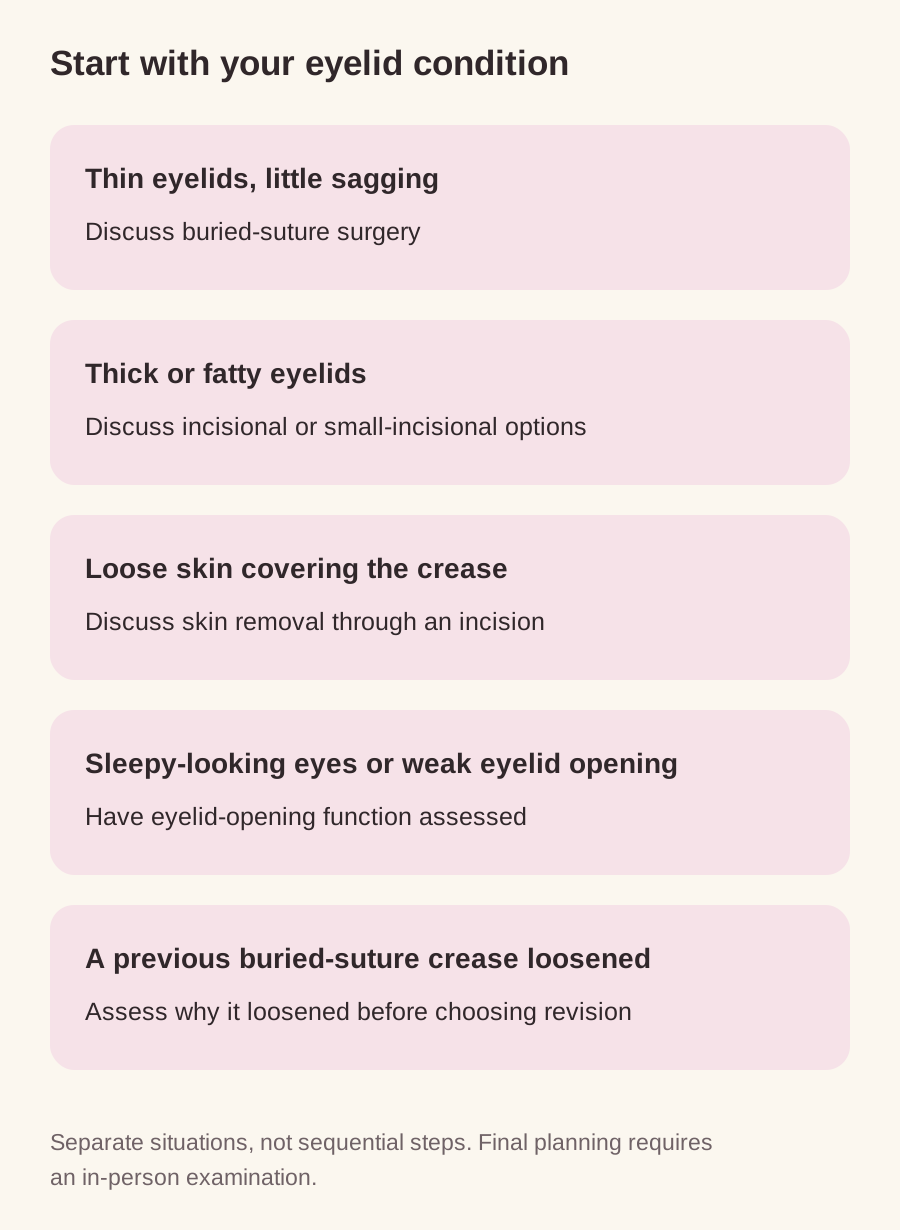
| Eyelid condition | Methods or issues to discuss | Reason and limitation |
|---|---|---|
| Thin, little sagging or fat | Buried sutures | Asan describes this use; 60% of the timing reviews described swelling subsiding within 2 weeks |
| Thick with more fat | Incision or partial incision | Four clinics describe incision-family approaches; research also includes buried sutures with fat removal |
| Sagging skin covers the crease | Incision | Allows excess-skin removal; one clinic describes substantial sagging as unsuitable for buried sutures |
| Sleepy appearance and weak opening | Assessment for ptosis correction | Concurrent correction appeared in 47% of incision reviews |
| Previous buried-suture crease loss | Establish the cause first | Buried sutures were the earlier method in 62 of 78 accounts naming it; examine fat and eyelid condition together |
Conclusion
Discuss buried sutures for thin lids with little sagging, and incision or partial incision when fat or excess skin needs addressing. Sleepy-looking eyes also need a separate assessment of eyelid-opening function. Explain the crease you want and your surgical history, then ask why the proposed method fits, what additional operations are involved, the recovery schedule and revision terms after loosening.
Frequently Asked Questions
What is the difference between buried-suture and incisional double-eyelid surgery?
Buried-suture surgery fixes a crease without a skin incision, while incision opens the skin to address fat and excess skin before fixation. Partial incision uses several short openings, with size and number varying between clinics.
Can buried-suture double eyelids loosen?
Yes. Figures differ from Asan Medical Center's guidance of no more than 5% to 22.3% revision in a two-point buried-suture cohort. Studies also found more revisions in those under age 20 and in patients without fat removal.
Can incisional double eyelids loosen?
Yes. A 4,129-patient study reported 2.1% partial loss; a Korean 680-patient study reported 14 partial and 4 complete losses. These were reports from teams studying their specific techniques.
How long does swelling after double-eyelid surgery last?
Among reviews specifying timing, 60% of buried-suture and 34% of incision accounts described 2 weeks or less. Asan gives about 1 week for ordinary activities and 2–3 months for settling. Concurrent ptosis correction in 47% of incision reviews also affects this comparison.
Will there be a scar?
Incisional surgery leaves an incision within the crease; clinic guidance describes color fading over 3–6 months. Noticeable scars appeared in 18 incision reviews, 14 partial-incision reviews and 2 buried-suture reviews.
Do thick eyelids always need incision?
No. Some buried-suture techniques add fat removal. Examine skin sagging and fat volume before deciding which tissue needs addressing and how the crease will be fixed.
Does crease surgery correct sleepy-looking eyes?
Crease surgery creates a fold, so eyelid-opening function needs separate assessment. Concurrent ptosis correction appeared in 47% of incision reviews. Mine Plastic Surgery Clinic describes partial incision as unsuitable for ptosis correction.
Which operation is used after buried sutures loosen?
Among 62 accounts naming buried sutures as the earlier operation, 31 described incision this time, 16 partial incision and 15 repeat buried sutures. Cheongdam Model publishes a repeat buried-suture case with non-incisional ptosis correction. The Swan notes that skin removed with incision cannot be restored.
Sources and verification dates
- Gangnam Seoyeon Plastic Surgery Clinic: buried sutures versus incision(clinic website, checked 2026-10-24): eyelid conditions, recovery and crease loss.
- 1 Percent Plastic Surgery Clinic: methods(clinic website, checked 2026-10-24): methods and partial-incision size.
- The Swan Plastic Surgery Clinic: method comparison(clinic website, checked 2026-10-24): buried sutures, natural adhesion, partial and full incision.
- JK Plastic Surgery Clinic: double-eyelid surgery(clinic website, checked 2026-10-24): openings and suture removal.
- Mine Plastic Surgery Clinic: partial incision(clinic website, checked 2026-10-24): technique and ptosis guidance.
- Resum Plastic Surgery Clinic: case guide(clinic website, published 2022-04-07, checked 2026-10-24): examples by eyelid condition.
- Cheongdam Model Plastic Surgery Clinic: buried sutures(clinic website, checked 2026-10-24): clinic cases.
- Asan Medical Center: double-eyelid surgery(hospital patient information, checked 2026-10-24): methods, loosening guidance of no more than 5%, recovery, complications and precautions.
- Okumura K et al. Age and revision after two-point buried sutures, Aesthetic Plast Surg 2025 (PMID 41171312)(abstract checked 2026-10-24): 600 cases.
- Okumura K et al. Fat removal and revision, Aesthetic Plast Surg 2026 (PMID 41361145)(abstract checked 2026-10-24): 188 versus 188 cases.
- Inoguchi K et al. HIROSHIMA Study, Arch Plast Surg 2026 (PMID 41907130)(abstract checked 2026-10-24): 513 patients.
- Inoguchi K et al. Transcutaneous versus conjunctival fixation, Aesthetic Plast Surg 2026 (PMID 42823516)(abstract checked 2026-10-24): 423 eyelids.
- Yang K et al. Incision-based fixation, Aesthetic Plast Surg 2026 (PMID 41249524)(abstract checked 2026-10-24): 4,129 patients.
- Kim HS et al. Korean incisional double-eyelid study, Plast Reconstr Surg Glob Open 2013 (PMID 25289207)(abstract checked 2026-10-24): 680 patients.
- Yu P et al. Small-incision systematic review, Aesthetic Plast Surg 2023 (PMID 36348097)(abstract checked 2026-10-24): 13 studies, 4,177 patients.
- Cao J, Yan L. Small versus full incision, Front Med 2024 (PMID 39355846)(abstract checked 2026-10-24): 333 patients.
- Su X et al. Seven-year Asian blepharoplasty complaint analysis, J Cosmet Dermatol 2025 (PMID 39998431)(abstract checked 2026-10-24): asymmetry complaints.
- Jeong Y et al. Ptosis correction after double-eyelid surgery, J Craniofac Surg 2024 (PMID 38710031)(abstract checked 2026-10-24): 18 patients.
- Liu R et al. Brow-position meta-analysis, Aesthetic Plast Surg 2023 (PMID 36890345)(abstract checked 2026-10-24): 2.52 mm brow lowering in the double-eyelid subgroup.
- Gangnam Unni reviews, Babitalk reviews (2026-10-24): 1,198 postoperative accounts analyzed from 11,655 records, comprising 400 buried-suture, 399 incision and 399 partial-incision accounts. Cross-platform duplicates remain possible. Swelling timing appeared in only 29–53 accounts per method. The percentages describe mentions in these review groups, not incidence among all patients.
Editorial responsibility and relationships
Prepared by the DermaFocus Editorial Team without medical professional review. Clinic examples are the clinics' published accounts, and reviews describe individual experiences; neither guarantees a result. DermaFocus has no advertising, contractual or affiliate relationship with the named clinics and received no payment or sponsorship. Individual diagnosis and surgical planning require a clinical examination.