
Key Summary
Among the Gangnam Unni and Babitalk filler reviews, 3,500 reviews with cc written were selected and classified, of which 3,454 were filler reviews. The amount received varies greatly depending on the area, with the lips, chin, and nose receiving 1cc, the nasolabial fold receiving 1cc to 2cc, and the forehead receiving 4cc to 6cc.
- Forehead size was 4.8cc on average, with 367 cases of 4cc, 332 cases of 5cc, and 282 cases of 6cc. Among forehead reviews, 22% were 3cc or less, and 12% (177 cases) were reviews of over 6cc.
- The nasolabial fold was 1cc in 42% (212 cases) and 2cc in 46% (232 cases), the lips were 1cc in 62% (149 cases), and the chin was 1cc in 60% (139 cases).
- Reviews about having the same area refilled were 25% (147) of 595 reviews of receiving filler, and 93 (30%) of 305 reviews about the forehead. The most common discomfort was swelling (335, 9.7%) and lumps were 126 (3.6%).
Although 93% of the reviews that wrote about the effect said it was good, 98% of the reviews that wrote about the timing were written within 1 month after the procedure, so it is impossible to know from the reviews how long the filler lasts.
How many ccs does the filler receive for each part?
The average amount received from the reviews was 4.8cc for the forehead, 3.2cc for the lateral cheek, 2.2cc for the front cheek, 2.1cc for the temple, 1.7cc for the nasolabial fold, 1.5cc for the under-eye area, 1.4cc for the chin, 1.3cc for the lips, and 1.0cc for the nose. The average of 102 reviews that only wrote cheek without dividing the area was 3.2cc.
| part | Review of capacity | average | Amount received a lot |
|---|---|---|---|
| forehead | 1,487 cases | 4.8cc | 4cc 367 cases, 5cc 332 cases, 6cc 282 cases, 3cc 216 cases |
| lateral cheek | 307 cases | 3.2cc | 88 cases of 2cc, 84 cases of 4cc, 68 cases of 3cc |
| frontcheek | 128 cases | 2.2cc | 60 cases of 2cc, 30 cases of 1cc, 25 cases of 3cc |
| temple | 323 cases | 2.1cc | 200 cases of 2cc, 59 cases of 1cc, 43 cases of 3cc |
| nasolabial fold | 509 cases | 1.7cc | 232 cases of 2cc, 212 cases of 1cc |
| under-eye area | 95 cases | 1.5cc | 58 cases of 1cc, 16 cases of 3cc, 14 cases of 2cc |
| chin | 233 cases | 1.4cc | 139 cases of 1cc, 68 cases of 2cc |
| lips | 239 cases | 1.3cc | 149 cases of 1cc, 65 cases of 2cc |
| nose | 58 cases | 1.0cc | 46 cases of 1cc |
The amount received is only the amount the writer wrote that he actually received, and the amount heard at the consultation or the unit price of 1cc was subtracted. The reviews written separately on both sides were counted in total. The average of 2,974 reviews reporting the total amount received in one visit was 4.2cc, with 33% under 2cc, 26% between 3 and 4cc, and 41% over 5cc.
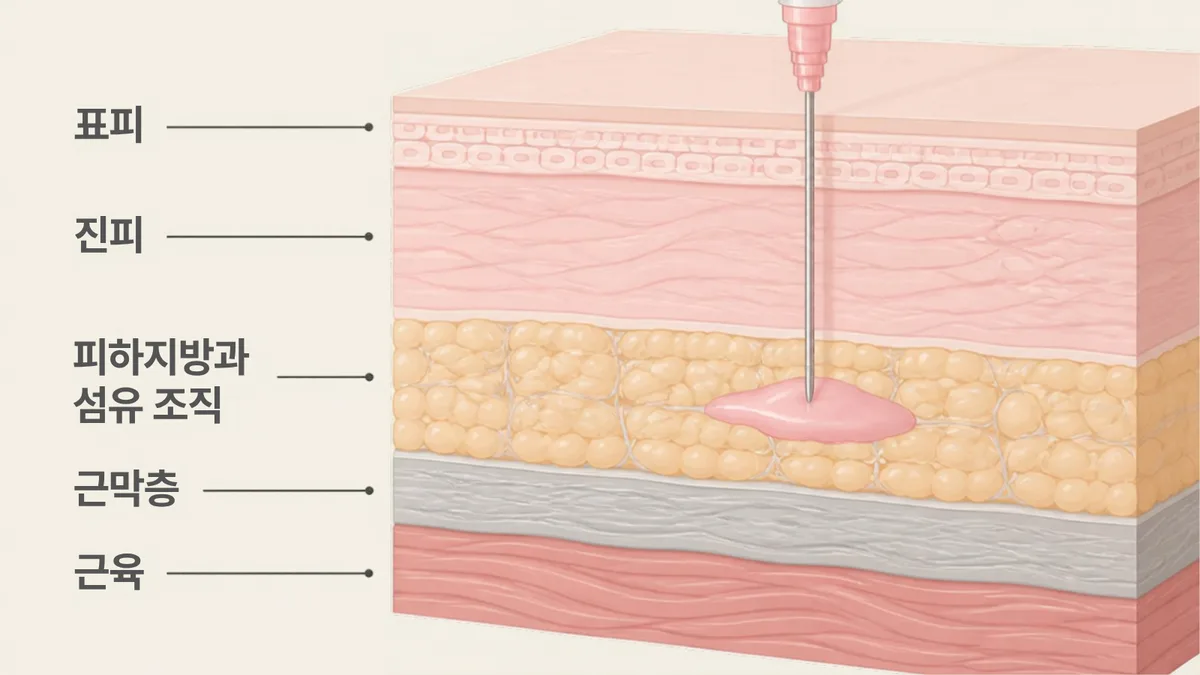
What is the largest cc of forehead filler?
Forehead capacity was the most common among 1,487 reviews, with 3.1cc to 4cc at 25%, 4.1cc to 5cc at 22%, and 5.1cc to 6cc at 19%, with the average being 4.8cc.
| Amount received | Number of reviews | ratio |
|---|---|---|
| 2cc or less | 103 cases | 7% |
| 3cc | 217 cases | 15% |
| 3.1cc to 4cc | 371 cases | 25% |
| 4.1cc to 5cc | 334 cases | 22% |
| 5.1cc to 6cc | 285 cases | 19% |
| Exceeding 6cc | 177 cases | 12% |
Of the 1,527 reviews of the effect of the 1,746 forehead reviews, 95% said it was good, and 12% (79 out of 666) said it was quite painful. For the forehead, 30% (93 out of 305) of the reviews said that the same area had been refilled, which was higher than the overall average (25%), while 5.8% (102) of the reviews mentioned lumping, and 11.8% (206) of the reviews mentioned swelling. Of the 555 product reviews on forehead, The Chaeum accounted for 51% (284 reviews).
How many ccs should the cheeks, temples, nasolabial fold, lips, and chin receive?
Cheek differed depending on the area with an average of 3.2cc on the lateral cheek and 2.2cc on the front cheek, 62% (200 cases) of temples had 2cc, and 88% of nasolabial folds had 1cc and 2cc combined.
| part | Amount received a lot | ratio |
|---|---|---|
| lateral cheek | 2cc 29%, 4cc 27%, 3cc 22% | 307 cases |
| frontcheek | 2cc 47%, 1cc 23%, 3cc 20% | 128 cases |
| temple | 2cc 62%, 1cc 18%, 3cc 13% | 323 cases |
| nasolabial fold | 2cc 46%, 1cc 42% | 509 cases |
| lips | 1cc 62%, 2cc 27% | 239 cases |
| chin | 1cc 60%, 2cc 29% | 233 cases |
| under-eye area | 1cc 61%, 3cc 17%, 2cc 15% | 95 cases |
| nose | 1cc 79% | 58 cases |
Research also addressed the relationship between the amount applied to the cheeks and the effect. In a study (Glaser et al., 2015) that looked at 235 people with mid-face depression, the proportion of patients evaluated as effective was higher in the area where the injection amount was larger, and when about 2.0 mL was injected in each lower area, correction was maintained for 24 months in the anterior cheek, 19 months around the cheekbones, and 15 months under the cheek. In a study that looked at 111 Chinese people (Ren et al., 2024), 76% improved at 6 months with an average of 3.4 mL, and 51% maintained at 12 months. In a study in which 1 mL was added to the lips of 36 Korean women (Rho et al., 2022), lip volume increased at 4 and 12 weeks. The latter average (lateral cheek 3.2cc, anterior cheek 2.2cc, lips 1.3cc) is close to the injection amount in these studies.
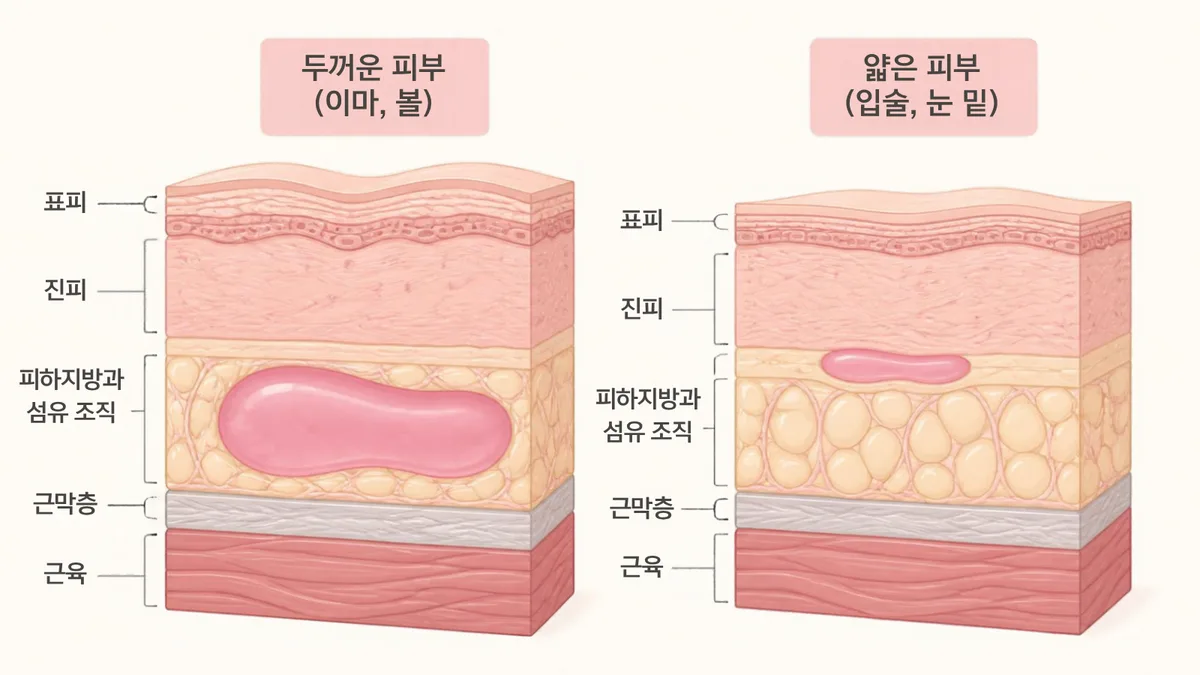
Filler What parts often appear in reviews?
Forehead was the most common with 1,746 cases, followed by nasolabial fold with 668 cases, temple with 498 cases, lips with 406 cases, lateral cheek with 381 cases, and chin with 325 cases. If there were multiple parts in one review, each part was counted.
| part | Number of reviews | Reviews with effects | positive-review rate |
|---|---|---|---|
| forehead | 1,746 cases | 1,527 cases | 95% |
| nasolabial fold | 668 cases | 563 cases | 93% |
| temple | 498 cases | 417 cases | 94% |
| lips | 406 cases | 368 cases | 91% |
| lateral cheek | 381 cases | 303 cases | 95% |
| chin | 325 cases | 275 cases | 93% |
| frontcheek | 244 cases | 198 cases | 95% |
| under-eye area | 160 cases | 136 cases | 88% |
| nose | 132 cases | 110 cases | 92% |
| Aegyo-sal | 63 cases | 56 cases | 88% |
The number of reviews is not a usage rate because it is a sample drawn from reviews with capacity expressions. The under-eye area and aegyo meat had a positive review rate of 88%, which was lower than other areas.
What was the effect of the filler and how much did it hurt?
Of the 2,944 reviews about the effect, 93% (2,743) said it was good, 120 (4%) said it was average, and 81 (3%) said it was ineffective.
Of the 1,113 cases that reported pain level, 611 cases (55%) said it was barely painful, 365 cases (33%) said it was bearable, and 137 cases (12%) said it was quite painful. Reviews that said it was quite painful by area were 12% in the forehead (79 out of 666), 12% in the lips (17 out of 142), 15% in the nasolabial fold (26 out of 174), 22% in the nose (12 out of 55), and 22% in the under-eye area (7 out of 32).
Of the 580 cases in which anesthesia was used, 391 cases (67%) were local anesthesia, 107 cases (18%) were anesthesia creams, 64 cases (11%) were sedation, and 18 cases (3%) said they received it without anesthesia. There were 533 first-time reviews and 589 re-treatment reviews, so there were slightly more reviews about re-treatment.
How often is the filler refilled?
Reviews regarding additional touch-ups on the same area were 147 (25%) out of 595 reviews for this item, and 93 (30%) out of 305 reviews for the forehead.
The average of 88 cases where the filler maintenance period was used was 15.2 months, but the number was written based on memory of the period for which the previously received filler was maintained, so the parts and products are mixed.
What was the inconvenience behind the filler?
Of the 3,454 reviews, the most common complaints were swelling 335 (9.7%), lumps 126 (3.6%), bruising 102 (3.0%), and pain 96 (2.8%).
| Reported inconvenience | Number of reviews | ratio |
|---|---|---|
| swelling | 335 cases | 9.7% |
| lump | 126 cases | 3.6% |
| bruise | 102 cases | 3.0% |
| pain | 96 cases | 2.8% |
| asymmetry | 45 cases | 1.3% |
| Overcorrection (too much) | 31 cases | 0.9% |
| Moving, smearing | 9 cases | 0.3% |
| Post about suspected vascular problems | 2 cases | 0.1% |
| Tindle (blue) | 1 case | 0.03% |
Reviews of swelling by area included temples 16.1% (80 out of 498), front cheeks 13.1% (32 out of 244), forehead 11.8%, lips 10.8% (44 out of 406), and swelling in forehead 5.8% and temples 5.0% (25). The under-eye area had bruising in 10.6% (17 out of 160 cases). There were 34 reviews (1.0%) that said they received a procedure to dissolve the filler (hyaluronidase), and 92 reviews said they regretted it or did not recommend it.
There are two reviews of vascular problems, but they are treated as serious complications even though they are rare in the study. A review of filler complications (DeLorenzi, 2014) summarizes that although ischemic complications are very rare, the exact incidence is unknown due to missing reports. The skin turns pale and blue-purple, followed by blisters and necrosis, and immediate hyaluronidase treatment is the key. In 2026, a review (Lowe et al.) discussed the use of a cannula, small injections, low injection pressure, and continuous movement of the needle tip as preventive measures, and concluded that the aspiration test does not definitively rule out intravascular injection. A review of hyaluronidase (Kroumpouzos, 2024) concluded that most hyaluronic acid filler complications can be treated safely and that vascular occlusion requires immediate high-dose administration.
Does filler have different effects depending on the product?
Among the 942 reviews that used the product, 331 (35%) were The Chaeum, 170 (18%) were Attier, 60 (6%) were Neuramis, 38 (4%) were Juvederm, and 34 (4%) were Restylane, and there was no difference between the products in the effectiveness comparison study. Most of the 3,454 reviews did not use the product name.
In a network meta-analysis (Elrosasy et al., 2024) that collected 579 people from 6 randomized trials of cheek filler, there was no difference in effectiveness between products at 1 month, 3 months, and 6 months, and safety differed depending on the product. The ratio of each product in the review is only the ratio of the names used in the sample and does not indicate superiority or inferiority of the effect.
How much is the filler?
The amount listed in the reviews is based on reviews that only received one part: the forehead was about 477,000 won (481 cases), the temple was about 302,000 won (32 cases), the lateral cheek was about 231,000 won (168 cases), the lips were about 187,000 won (141 cases), the nasolabial fold was about 170,000 won (123 cases), the nose was about 156,000 won (36 cases), and the chin was about 156,000 won (36 cases). It was 139,000 won (73 items).
| part | Average review price | Number of reviews | average capacity |
|---|---|---|---|
| forehead | Approximately 477,000 won | 481 cases | 4.8cc |
| under-eye area | Approximately 375,000 won | 37 cases | 1.5cc |
| temple | Approximately 302,000 won | 32 cases | 2.1cc |
| lateral cheek | Approximately 231,000 won | 168 cases | 3.2cc |
| lips | Approximately 187,000 won | 141 cases | 1.3cc |
| nasolabial fold | Approximately 170,000 won | 123 cases | 1.7cc |
| nose | Approximately 156,000 won | 36 cases | 1.0cc |
| chin | Approximately 139,000 won | 73 cases | 1.4cc |
The review amount is the payment amount written on the platform, so it is a mixture of product, anesthesia, and concurrent procedures, and is not the same standard as the clinic's published price per 1cc. There are 37 and 32 reviews for under-eye area and temple, so the sample is small.
How was the filler capacity viewed in the study?
The study did not present a standard cc for each area, and in the cheek and lips study, a relationship was reported between the injection volume used (approximately 2.0mL to 3.4mL, lips 1mL) and the duration of effect.
| Research | target | Results |
|---|---|---|
| Glaser DA et al., Dermatol Surg 2015 | 235 people with mid-face cheek space defect | The response rate was higher in areas with larger injection volumes, and the duration of correction was 15 to 24 months (24 months for the anterior cheek, 19 months for the cheekbones, and 15 months for the lower cheek) at a total volume of about 2.0 mL. |
| Ren R et al., J Cosmet Dermatol 2024 | 111 Chinese people, average 3.4mL | The 6-month response rate was 76%, the no-treatment group was 8%, and at 12 months, 51% was maintained, and the 3D volume change was 3.6mL. |
| Rho NK et al., J Clin Med 2022 | 36 Korean women lips 1mL | At 4 and 12 weeks, the volume and protrusion of the lips increased, and for fillers with medium cross-linking density, the lip lifting angle became steeper. |
| Elrosasy A et al., Arch Dermatol Res 2024 | Cheek filler test part 6 579 people | There was no difference in the effects between products at 1 month, 3 months, and 6 months. |
The injection amount in the study is set in the research protocol and is not based on clinic consultation standards. Standard guidelines for determining the required cc for each part were not provided in the paper, and were only shown as a distribution in the latter part.
Where did DermaFocus have a high positive-review rate in filler reviews?
Based on reviews, the areas with the highest positive-review rates were the forehead, lateral cheek, anterior cheek (all 95%), and temple (94%), while the under-eye area and aegyo-sal (88%) had relatively low rates.
The amount in the reviews for each area of concern is as follows.
| Part written in review | A lot of money received from reviews | positive-review rate (effective reviews) | Average review price |
|---|---|---|---|
| forehead | 4cc to 6cc, average 4.8cc | 95% (1,527 cases) | Approximately 477,000 won |
| lateral cheek | 2cc to 4cc, average 3.2cc | 95% (303 cases) | Approximately 231,000 won |
| nasolabial fold | 1cc or 2cc, average 1.7cc | 93% (563 cases) | Approximately 170,000 won |
| lips | 1cc, average 1.3cc | 91% (368 cases) | Approximately 187,000 won |
| chin | 1cc, average 1.4cc | 93% (275 cases) | Approximately 139,000 won |
- The forehead had the highest number of reviews and received an average of 4.8cc, but the touch-up rate was 30% and the lumpiness was 5.8%, which was higher than other parts.
- The lateral cheeks had similar sizes of 2cc, 4cc, and 3cc, and the swelling was 6.6% (25 out of 381 cases). The average size was 3.2cc, which is two-thirds of the forehead.
- Nasolabial fold, lips, and chin were mostly determined within 1cc and 2cc, and the positive-review rate was 91% to 93%.
There are other parts with good reviews. Temple was good in 94% (417 cases), 2cc was good in 62%, and front cheek was good in 95% (198 cases), and 2cc was good in 47%.
93% of the reviews about the effect said it was good, but most of them were written right after the procedure. This comparison is based on reviews, not medical superiority or inferiority, and the results of the procedure vary from person to person, so the ratio of reviews does not guarantee the results. During the consultation, please confirm the amount you will receive for each area, the exact name of the product, and the total price.
filler What should I ask during a consultation?
Start by asking how many ccs of product are put into each area and whether there is an additional charge for touch-up. Reviews showed that the amount received for the same area was more than twice as different, and 12% of reviews on the forehead received more than 6cc.
| What to check | askcheek questions |
|---|---|
| Product | What is the product and can I confirm that it has been opened? How many 1cc syringes do you use? |
| Capacity | How many ccs per area and how many ccs in total? Do you put it all in at once or in parts? |
| Injection method | Is it a needle or a cannula? At what depth do you put it? |
| Anesthesia and Pain | Is it numbing cream or local anesthesia? How much does it hurt? |
| touch-up | If it's not enough, can you add more? How much does it cost extra? |
| When a problem arises | If I have vascular problems or lumps, can I dissolve them with hyaluronidase? Do you have emergency contact information? |
| price | Is it per cc or total? Are VAT and anesthesia included? |
| Actual practitioner | Does the doctor I consult perform the procedure themselves? |
DermaFocus compares filler clinics like this:
The recommendation guide applies the same four criteria to all clinics.
| Comparison Items | Verification criteria |
|---|---|
| Treatment information | CC information for each product and area, injection method (needle, cannula), and whether or not information will be disclosed in case of complications |
| medical staff | Specialist qualifications and actual practitioners confirmed by official sources |
| cost | Confirmation date, VAT, price conditions, CC standard and total amount |
| Reviews | Repeated mention of sources, writing time, consultation and explanation for each platform |
The number of reviews and specialist qualifications are not used as scores to guarantee treatment results. The role of a recommendation guide is to display confirmed facts side by side using the same standards.
How this article was checked
The DermaFocus editorial team organized the reviews and research papers, and they were not supervised by medical professionals. This article does not constitute a medical diagnosis or recommendation for treatment, so please consult with a medical professional to determine whether and how to perform the procedure.
- Reviews: Among the filler reviews of Gangnam Unni and Babitalk, we randomly classified 3,500 reviews (1,417 Gangnam Unni, 2,083 Babitalk, as of October 8, 2026) from 7,425 reviews with dosage expressions such as cc in the text. Among them, 3,454 filler reviews are the subject of this article, excluding non-facial procedures such as breasts and hips, collagen procedures, and fat grafting.
- Analysis standard: The dose by area is based on reviews that describe the area, the effect ratio is based on 2,944 cases that wrote about the effect, the degree of pain is based on 1,113 cases, touch-up is based on 595 cases, anesthesia is 580 cases, and the total amount is based on 2,974 cases.
- Studies: 3 midface and lips capacity studies, 1 cheek filler meta-analysis, and 3 reviews on vascular complications and hyaluronidase from PubMed. Only the abstracts were checked.
- Price: These are payment amounts stated in reviews. Among the reviews that only received one part, the average amount was between 10,000 won and 3 million won, and the clinic's publicly disclosed price was not included in this article.
- Limitations: Of reviews that stated a time point, 98% were written within one month after treatment. Since it is a sample drawn from reviews with capacity expressions, the capacity distribution is not the distribution of all users, and the number of reviews for each part is not the usage rate.
- Privacy: Review text, authors and clinic names are not reproduced.
Frequently Asked Questions
How many cc of filler are needed for each area, and how is that decided?
The amount varied substantially by treatment area in the reviews. Lips, chin, and nose had 1cc in 60% to 79% of cases, nasolabial folds had 1cc in 42% and 2cc in 46%, temples had 2cc in 62%, lateral cheeks had an average of 3.2cc, and forehead had an average of 4.8cc. The studies did not provide a standard volume for each area, so confirm the amount and product for each area during the consultation.
How many ccs does the forehead filler take?
The average of 1,487 reviews was 4.8cc, with 367 cases of 4cc, 332 cases of 5cc, and 282 cases of 6cc. 22% were 3 cc or less, and 12% were greater than 6 cc.
How many cc is the nasolabial fold filler?
Of the 509 reviews, 46% (232) were 2cc, 42% (212) were 1cc, and the average was 1.7cc. The positive-review rate was 93%.
How many cc is the lips filler?
Of the 239 reviews, 62% (149) were 1cc, 27% (65) were 2cc, and the average was 1.3cc. In a study in which 1mL was added to the lips of 36 Korean women, lip volume increased at 4 and 12 weeks.
How many ccs does cheek filler take?
The lateral cheek averaged 3.2cc (307 cases), the anterior cheek averaged 2.2cc (128 cases), and the undivided cheek averaged 3.2cc (102 cases). In the study, approximately 2.0 mL to 3.4 mL was placed in the midface.
Do you often refill the filler?
There were 147 out of 595 (25%) reviews of additional touch-ups on the same area, and 93 out of 305 (30%) reviews on the forehead.
How much does a filler hurt?
Of the 1,113 reviews about the level of pain, 55% said it was barely painful, 33% said it was bearable, and 12% said it was quite painful. Local anesthesia was used in 67%, numbing cream was used in 18%, and sedation was used in 11%.
What inconveniences arise after filler?
Swelling was the most common with 335 cases (9.7%), lumps with 126 cases (3.6%), and bruising with 102 cases (3.0%), and there were two posts about suspected vascular problems. Studies have shown that vascular complications are rare but serious and that immediate hyaluronidase treatment is the focus.
How long does the filler last?
Reviews cannot establish this. 98% of the 1,337 reviews were written within one month after the procedure. In the study, correction at about 2.0mL of the midface was maintained for 15 to 24 months, and in a study with an average of 3.4mL, 51% was maintained at 12 months.
How much does the filler cost?
The amount written in the review was about 477,000 won for the forehead, about 231,000 won for the lateral cheek, about 187,000 won for the lips, about 170,000 won for the nasolabial fold, and about 139,000 won for the chin, based on reviews of only one part. The payment amount is a mixture of the product, anesthesia, and concurrent procedures.
Sources and verification dates
- Glaser DA et al. Continued effectiveness by injection volume and sub-region for midfacial cheek volume defects, Dermatol Surg 2015 (PMID 26218727)(confirmed 2026-10-08): 235 patients, response rate by injection volume quartile, 15 to 24 months of correction at approximately 2.0mL
- Ren R et al. Asian midfacial hyaluronic acid filler randomized multicenter trial, J Cosmet Dermatol 2024 (PMID 38487954)(confirmed 2026-10-08): 111 patients, mean 3.4 mL, 76% at 6 months vs. 8% at 12 months 51% maintained
- Rho NK et al. Hyaluronic acid filler lips lifting seen in 3D photos, J Clin Med 2022 (PMID 35956168)(confirmed 2026-10-08): 36 Korean women, lips 1mL, increase in lips volume at 4 and 12 weeks
- Elrosasy A et al. Cheek volume increase hyaluronic acid filler network meta-analysis, Arch Dermatol Res 2024 (PMID 39708174)(confirmed 2026-10-08): 6 trials, 579 people, no difference in effectiveness between products
- Lowe S et al. Prevention and treatment of hyaluronic acid filler vascular occlusion, J Cosmet Dermatol 2026 (PMID 42087426)(confirmed 2026-10-08): Cannula, microcheeklus, low pressure, limitations of aspiration test
- DeLorenzi C. filler Complications Part 2 Vascular Complications, Aesthet Surg J 2014 (PMID 24692598)(Confirmed 2026-10-08): Ischemic complications are rare and the incidence is unknown due to missing reporting. Immediate treatment with hyaluronidase.
- Kroumpouzos G et al. Hyaluronidase application and dosage review for filler complications, JMIR Dermatol 2024 (PMID 38231537)(confirmed 2026-10-08): Most complications can be treated, vascular occlusion can be treated immediately with high dose
- Gangnam Unni review and Babitalk review (platform review, confirmed 2026-10-08): Based on random classification of 3,500 out of 7,425 filler reviews. The original text of the review is not included.
Editorial responsibility and relationships
DermaFocus has no advertising, contract, or affiliation with any of the clinics or manufacturers mentioned in this article, and has not received any money or sponsorship. This article is a compilation of information needed to select a procedure and does not replace a personal diagnosis or treatment plan.