
Key Summary
If you are concerned about sagging skin, we recommend FX treatment. If you do not have a lot of fat but are concerned about sagging and fine wrinkles, we recommend Forma treatment. This is because the manufacturer divides the areas targeted for each treatment like this.
- If you are concerned about pinching your skin, we recommend FX.
- If you are concerned about sagging and fine wrinkles, we recommend Forma.
- If you have both concerns, listen to an explanation as to why you should use one for each part.
- If you already have cheek hollowing, decide which part to reduce and which part to keep.
Looking at 4,724 reviews, 41 out of 49 reviews comparing FX and Forma (84%) said FX was more painful or hotter, and 11 of them said it was tolerable. Almost half of the reviews said that there were bruises and those that said there were no bruises, and some wrote that about 90% disappeared within a week. However, there are no studies that have verified FX on the face, so this article does not promise effectiveness.
Who are InMode FX and Forma better suited for?
If you have pinchable fat, compare FX first, and if you have sagging skin and fine wrinkles, compare Forma first. The picture and table below translate the manufacturer's target parts and reviews by concern.
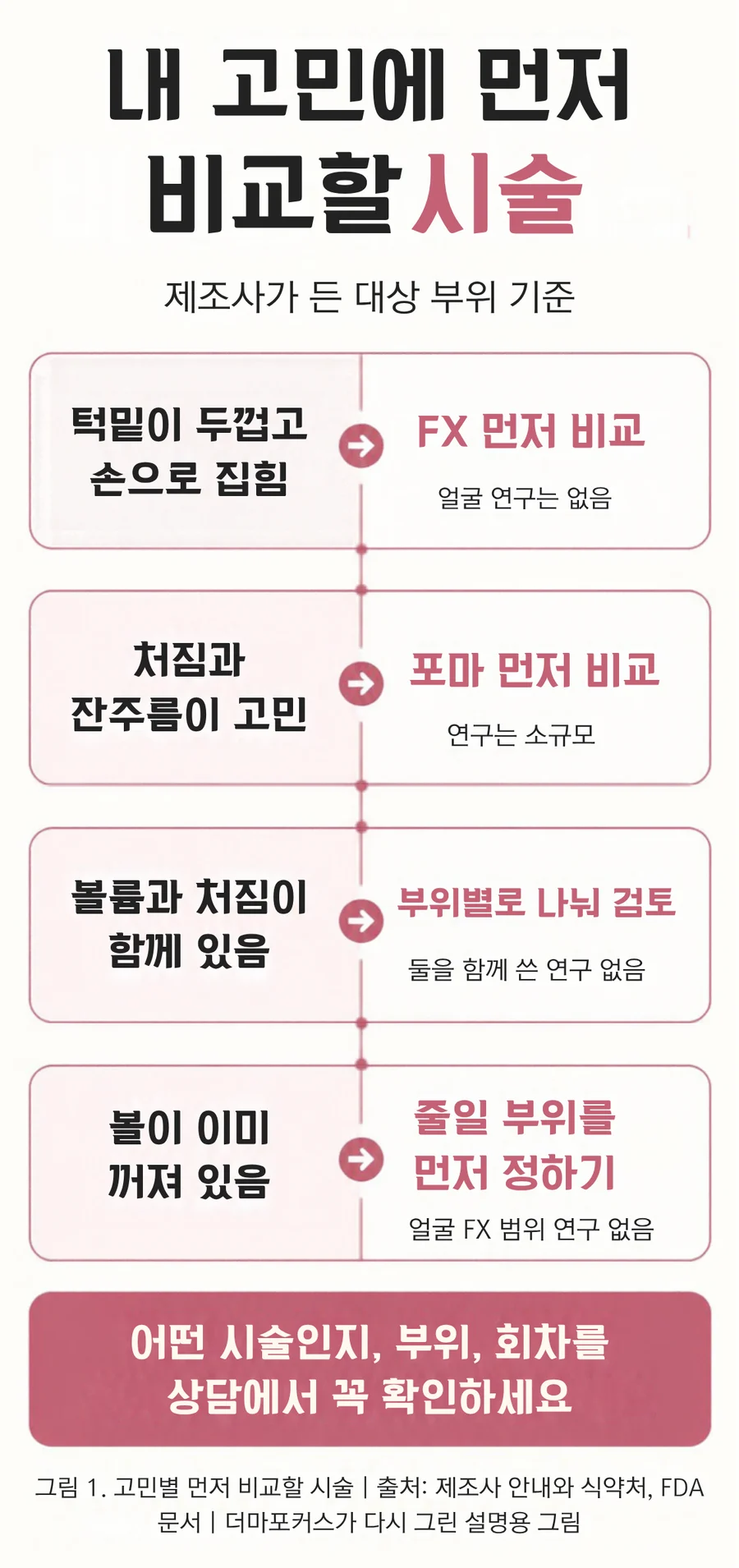
| My concerns | Treatments to compare first | Reasons and Limitations |
|---|---|---|
| The area under the chin is thick and pinched by hand | FX | A domestic manufacturer provides guidance targeting double chins. However, there is no facial research |
| There is little facial fat, but the jawline and cheeks are sagging | Forma | The manufacturer advises targeting jowls and nasolabial folds. The study was small |
| Concerned about fine wrinkles and skin texture | Forma | Facial Wrinkles Are Subject to Manufacturer Guidance and FDA Documentation |
| Both fat and sagging | Assess each area separately | There is no study that used the two together, so the reasons for each part must be heard |
| Existing cheek hollowing | Choose only after identifying which areas to reduce and preserve | No research on how much FX reduces fat anywhere on the face |
What kind of person is FX better suited for?
People who have fat under their chin or lower cheeks that pinches with their hands and want to reduce that area should compare this treatment first. FX absorbs the skin and sends heat to reach the fat layer beneath the skin.
- People like this: The area under the chin looks thick from the front, and when you hold it with your hand, the skin pinches.
- Rationale: A domestic manufacturer's site wrote about "double chin and sagging cheeks." This statement is an advertisement-reviewed guide.
- Limitations: We could not find any papers that used FX on the face or under the chin. All fat loss studies were on the abdomen, so it was not confirmed how much was lost on the face.
- Check first: Ask the medical staff if they can tell whether it is fat or sagging skin that you are pinching.
- Please note: FX is more painful and bruises are mentioned more frequently than Forma. Please read the Pain and Bruising section below first.
What kind of person is Forma more suitable for?
This is the treatment that people who do not have a lot of weight but are concerned about blurred jaw line, sagging skin, or fine wrinkles should compare first. Forma transfers heat by moving over the skin without suction, targeting the elastic layer within the skin.
- People like this: I don't have any issues, but my jaw line is blurred and I'm concerned about fine wrinkles around my forehead, eyes, and nasolabial folds.
- Rationale: The manufacturer advises using the product for the forehead, eye area, nasolabial folds, jowls, and neck, and the FDA document also lists facial wrinkles as an indication. In a study of 14 people on the face and neck, everyone evaluated that it had improved, and in a study of 22 people with sagging under the chin, there was also a statistically significant improvement.
- Limitations: All were small, had no control group, and the study authors had ties to the manufacturer. The study was repeated four to eight times.
- What to check first: Get an explanation as to whether the cause of my sagging is skin or fat.
- If you are worried about pain or bruising: Forma had far fewer reviews of pain and bruising than FX. There was also one review saying that they chose Forma because they were worried about bruising due to their job.
If I have both excess fat and sagging, should I get FX and Forma together?
It is not necessary to receive them together, and there is no evidence to say that it is better to receive them together. We could not find any studies that compared or used the two procedures together.
Approximately 1,700 out of 4,724 (36%) reviews said they received FX and Forma together, but there is no data comparing the effects. In places where parallel use is recommended, it is a good idea to hear an explanation as to why one is used for each part.
Can I get FX even if I have low facial fat or saggy cheeks?
There is no research on how much FX reduces fat on the face, so there is no evidence to say what the safe range is for those with less facial fat. So, rather than deciding whether to get it or not, you should first decide where to reduce and where to keep.
Ask these three questions in your consultation.
- Do you mark on your face which areas to reduce and which areas to keep?
- How many times do you check the progress and decide whether to continue or stop?
- If the cheek is already off, how do you deal with that area?
How was the pain different between InMode FX and Forma in the reviews?
Reading 49 reviews of the two procedures side by side, 41 (84%) said FX was more painful or hotter. Of those, 11 (27%) said it was “tolerable.”
| Review Category | number of cases | ratio |
|---|---|---|
| FX was more painful or hotter | 41 cases | 84% |
| Forma hurts more or is hotter | 2 cases | 4% |
| Both were painful | 4 cases | 8% |
| Neither of them hurt | 2 cases | 4% |
In the reviews, the feelings of the two procedures were different.
- FX: There were about 50 reviews saying that it sucked the skin like cupping and the heat built up over time, making it more painful in the second half. There were about 70 reviews that mentioned a tingling sensation at the end, about 10 reviews that said it hurt momentarily in areas where there was flesh, such as under the chin, and 2 reviews that said it was less painful in areas where there was flesh, such as the cheeks.
- Forma: The largest number of reviews (about 170) compared it to a “warm massage” or “warm,” and about 30 reviews said that it was enough to put them to sleep.
- Exception: Of the two reviews that said the Forma was more painful, one said the Forma was so hot that it caused burns.
- Adjustment: There were about 36 reviews saying that they lowered the level or intensity when they said they were in pain. There was one review where the patient was lowered from level 4 to level 3 during the procedure and one review where they filled the time with Forma because they could not tolerate FX. There were about 320 reviews that mentioned anesthesia, and about 50 reviews that said they received it without anesthesia, and one of them wrote that they did not receive anesthesia after hearing that applying numbing cream would increase the risk of burns because they would not be able to feel the heat.
Of the 4,724 reviews, we read and confirmed 49 reviews comparing the two procedures. Because reviews are self-reported, these figures describe reported experiences and are not clinical incidence rates.
How long can bruising last after InMode, and which treatment mentions it more often?
Reports of bruising and no bruising were nearly even (248 versus 239), and bruising was mentioned about twice as often in FX reviews as in Forma reviews. The proportion of reviews that mentioned bruising was 15-31% for those who received only FX, and 8-12% for those who received only Forma.
This is what the 191 reviews said about how long it took for the bruises to disappear.
| Until the bruises disappear | Review Rate |
|---|---|
| Within 3 days | 33% |
| 4-5 days | 24% |
| About 1 week | 35% |
| 10 days or more | 8% |
In other words, about 90% disappeared within one week. There were 16 out of 191 reviews that said they stayed for more than 10 days, and about 70 reviews that said they were prone to bruising or had thin skin. There were about 40 reviews saying that they received bruise cream after the procedure.
- Redness and swelling: There were about 50 reviews that said it subsided within the same day or two days. The manufacturer's manual also wrote that both treatments typically disappear within 24 hours.
- Downtime: There were about 150 reviews saying that they were able to return to their daily lives immediately or that there was almost no downtime.
- When making an appointment: There were about 20 reviews saying they were worried about their job or schedule because of the bruises, and 5 gave advice to leave more time in their schedule.
What are the side effects and burn risks of InMode?
Out of 4,724 reviews, only 2 claimed actual skin damage. One review said that there was a burn on the cheek after the Forma treatment (the author claimed it was a clinic error), and one review said that pus formed on both cheeks and scabs formed after the procedure. This is an individual case that cannot be confirmed.
- Manufacturer's Manual: Both treatments list blisters, burns, pigment changes, and scars as side effects. This list is the same for both procedures and was only confirmed in one copy of the 2018 manual.
- Similes in reviews: There were about 30 reviews that mentioned the word burn. Most of them were metaphors that emphasized heat, such as “It was hot as if you would get burned,” and there was also a review that said, “It wasn’t hot enough to get burned.”
- Response: There were about 36 reviews saying that they lowered the level or intensity when it was too hot, and this was the response confirmed in the reviews.
What should you tell your clinician before an InMode treatment?
Do not perform the procedure if you have electronic devices or metal implants in your body, or if you are pregnant or lactating, the manufacturer's manual states. There are no contraindications for each procedure in the Korean MFDS public document, so the following is based on the manufacturer's manual.
| Category | If applicable |
|---|---|
| No treatment | Pacemaker or defibrillator, metal or electronic implants anywhere on the body, pregnancy and lactation, history of cancer or skin cancer, wounds and eczema, psoriasis, rash at the treatment site |
| postpone schedule | Taking isotretinoin (acne medicine) within 6 months, filler, collagen, and fat injection areas within 6 months, other light, laser, and high-frequency procedures within 3 months |
| Consult your doctor first | Taking anticoagulants, keloids or wounds that do not heal well, heart disease, epilepsy, uncontrolled high blood pressure and diabetes, liver or kidney disease, decreased immunity, recurrent herpes simplex |
It is written in the Korean MFDS Instructions for Use document that all metal accessories on the body must be removed before the procedure.
How are the principles different between InMode FX and Forma?
FX sucks in the skin and sends heat to the fat layer, while Forma moves over the skin and warms the elastic layer. InMode is the name of the device, and FX and Forma are different parts (handpieces) that are attached to the end of the device. In clinics, these parts are called “FX treatment” and “Forma treatment.”
There are two types of FX: those used on the face and small areas (MiniFX) and those used on large areas such as the stomach (BodyFX). They use MiniFX for the face, but in clinics they both just call it "FX" so check which one it is. The abdominal study results were generated with BodyFX and should not be directly transferred to facial MiniFX.
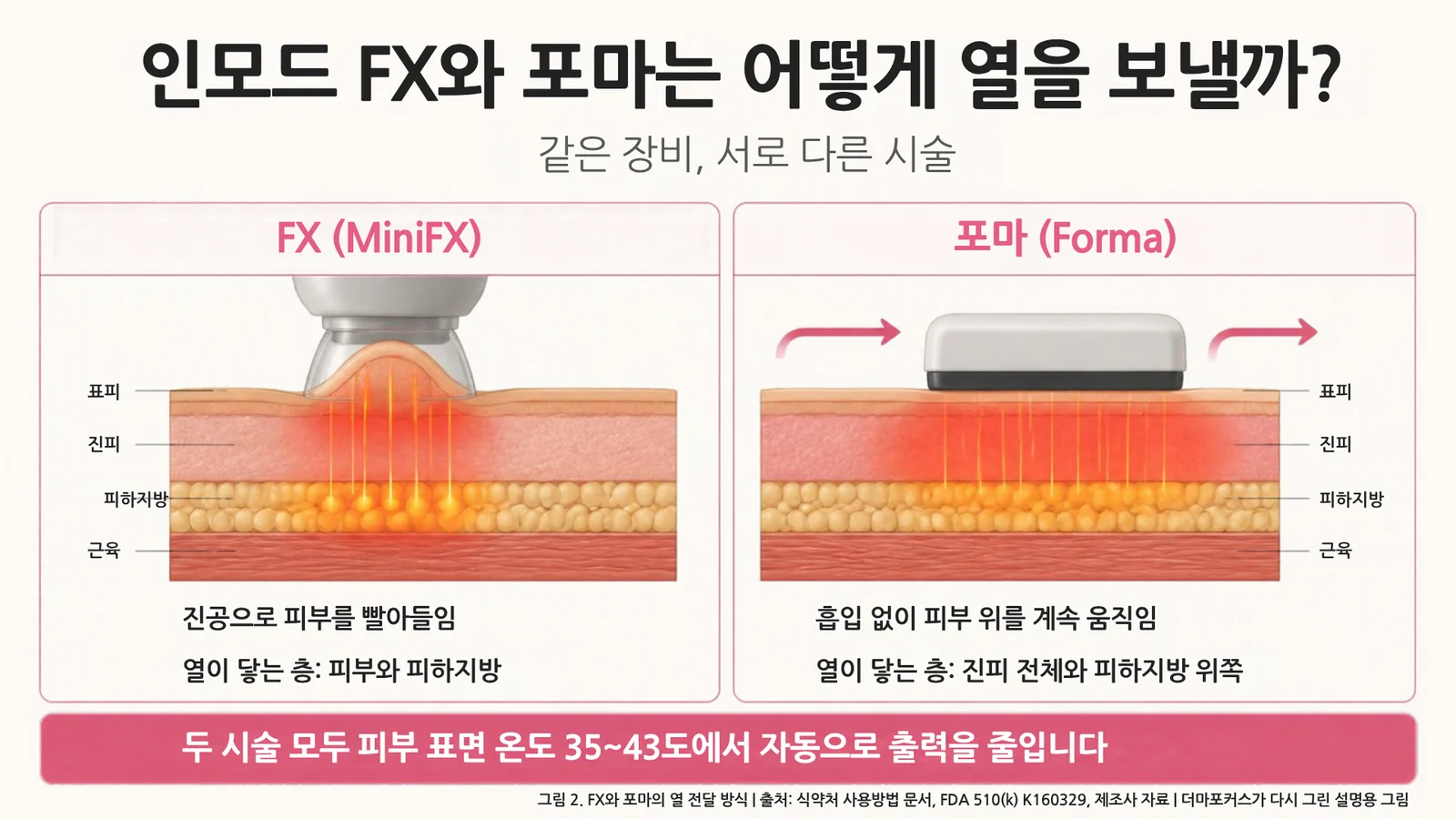
| Comparison Items | FX treatment (MiniFX) | Forma treatment |
|---|---|---|
| method | High-frequency heat transfer while sucking the skin | High-frequency heat transfer in continuous motion without suction |
| Layer where heat reaches | Skin and fat layer beneath the skin | The entire elastic layer inside the skin and above the fat layer |
| temperature management | Set to 35~43 degrees of skin surface, automatically shuts off when exceeded | Same scope (based on Korean MFDS usage document) |
| Target area with manufacturer | Double chin, arms, knees, cellulite | Forehead, eye area, nasolabial fold, chin, neck |
| Manufacturer Manual Schedule | About 8 sessions, once weekly, maintenance every 3 to 6 months | About 6 sessions, once weekly, maintenance every 1 to 3 months |
| Later expressions of pain | Hot and painful in the second half, bearable | warm massage |
| Bruises of later stages | Frequently Mentioned | Less mentioned |
| Research basis | Abdominal fat studies only | Facial wrinkles, submental and biopsy small studies |
How are InMode FX and Forma licensed in Korea?
In Korea, FX and Forma are included together in one device permit, and the only permitted use purpose is “a device for coagulating tissue with high-frequency current.” Korean MFDS approved this device as a general-purpose electrosurgical device (Class 3, License No. 19-352), and the review was also based on technical documents, not clinical data. There is no mention of fat reduction, lifting, or wrinkle improvement in the permit document.
The US FDA document is similar. The indications for FX are relief of muscle pain and muscle spasms, improvement of local blood circulation, and temporary reduction of the appearance of cellulite, and the indications for facial wrinkles are attached to a part called WMface. We could not confirm in the document whether Forma and WMface are the same part. FDA 510(k) is a procedure to check whether the device is substantially the same as an existing device, so it does not approve the clinical effectiveness.
Phrases such as "Fat cell death, double chin improvement" on the manufacturer's domestic site are advertisement-reviewed instructions and are different from the permitted use purpose.
How much of an InMode effect was there in the study?
Forma improved the majority of participants in a small study on the face, while FX reduced fat thickness in the abdomen. Both results were small and had no control group.
| Treatment | Research | Results |
|---|---|---|
| Forma | Face and neck, 14 women, 4–6 sessions, once weekly | All 14 people evaluated that it had improved (21% clearly, 50% moderately, 29% slightly) |
| Forma | 4 people scheduled for face lift, biopsy after 8 times, once a week on one side only | Collagen in the skin increased by 7.9%, collagen synthesis increased by 34.7% |
| Forma | 22 patients with sagging under the chin, 4 times at 2-week intervals | Statistically significant improvement in submental sagging score and fat volume (up to 6 months). No size figures in abstract |
| FX | Abdomen, 20 women, 8 sessions, once weekly | After 3 months, fat thickness decreased by 39.6% and volume decreased by 428.5cc |
| FX | Abdomen 21 people, 6 sessions, once weekly | After 3 months, abdominal circumference decreased from 113.4cm to 110.7cm, and subcutaneous fat thickness decreased from 40.5mm to 38.5mm. Weight change not significant |
There are three things to look for when reading a study.
- These are all results obtained multiple times. The study was repeated 4 to 8 times, and there was no study that showed an effect after just one use.
- FX is not a facial result. We could not find any studies using FX on the face or under the chin, so the abdominal 39.6% should not be read on the face.
- This is a study related to the manufacturer. The authors of the Forma 14-person study received travel expenses and honoraria from the manufacturer, and some had stock options, while for the FX 20-person study, the manufacturer lent the device. We could not find any randomized controlled trials of either procedure.
How many InMode sessions are used, how long is each session, and how long might results last?
The schedule in the manufacturer's manual is about 6 weekly sessions for Forma and 8 weekly sessions for FX, and all studies were repeated several times. There is no frequency recommendation on the official domestic site or in the Korean MFDS document.
| Treatment | Manufacturer's Manual | Schedule written in the study |
|---|---|---|
| Forma | About 6 sessions, once weekly (up to 10 times depending on the person), 15-30 minutes per time, maintenance once every 1-3 months | 4–6 sessions, once weekly, 8 sessions, once weekly (10 to 15 minutes per area), 4 times at 2-week intervals |
| FX | Around 8 sessions, once weekly (up from 6 times to 2-4 additional times), 20 minutes per area, maintenance once every 3-6 months | 6 times once a week, 8 times once a week |
This manual is a copy of the 2018 version posted by a third party, so I have not been able to confirm whether it is still the same. The maintenance period is the manufacturer's guide that "the results can be maintained if you retake the product at this interval," and is not a verified data on how long it will actually be maintained. If you see instructions for “1-time experience” or “3-time package,” ask how many times it stops and by what criteria.
What are some common misconceptions about InMode?
The statement that "FX permanently destroys fat cells" is only an explanation by the paper's author and the seller and is not an accepted fact. The explanation that fat cells are killed by high-voltage pulses only appears in the paper and the manufacturer's domestic site, and there is no indication for fat reduction in the Korean MFDS and FDA documents.
"FX is strong and Forma is weak" is also not correct. The two treatments are different not in intensity but in method and targeted layer, and the skin surface temperature setting range is the same.
What should I ask during a consultation?
Be sure to check the type of treatment (FX or Forma), area, and number of sessions during the consultation. If this is missing, you cannot compare what you receive even if it is the same InMode.
| What to check | Questions to Ask |
|---|---|
| Cause of my troubles | Is the area under my chin fat or sagging skin? |
| Type of treatment | Is FX for the face (MiniFX)? Do you also do Forma? |
| Scope of treatment | Do you have a double chin, jawline, lower cheeks, or neck? |
| Rounds and Intervals | How many sessions do you plan, at what intervals, what do you watch and stop at? |
| time | How many minutes does each treatment take for each area? |
| Pain Control | If it hurts, do you take it down a notch? Do you use numbing cream? |
| facial fat | Do you indicate which areas to reduce and which areas to keep? |
| Actual practitioner | Does the doctor I consult perform the procedure themselves? |
| Check progress | Do you compare progress with photos taken under the same conditions? |
What is the basis for comparing InMode prices?
If you match the price for one time, you can compare products with different treatment types, scopes, and times.
| Comparison criteria | What to check |
|---|---|
| Type of treatment | FX Exclusive, Forma Exclusive, Both |
| range | Includes double chin, jawline, lower cheek, and neck |
| Quantity | Time per procedure |
| Episode | Is it a one-time price or a multiple-time package? |
| Total cost | Whether VAT, anesthesia, additional procedures are included |
| Pricing Terms | First Visit Price, Limited Time, Date Surveyed |
| medical staff | Names and qualifications of consulting doctors and actual practitioners |
The amount and conditions for each clinic are organized with the source and confirmation date in the recommendation guide.
How DermaFocus compares clinics offering InMode
The recommendation guide applies the same four criteria to all clinics.
| Comparison Items | Verification criteria |
|---|---|
| Treatment information | Treatment type, scope and frequency, and whether post-treatment information is disclosed |
| medical staff | Specialist qualifications and actual practitioners confirmed by official sources |
| cost | Confirmation date, VAT, price conditions, times |
| Reviews | Repeated mention of sources, writing time, consultation and explanation for each platform |
The number of reviews and specialist qualifications are not used as scores to guarantee treatment results. The role of a recommendation guide is to display confirmed facts side by side using the same standards.
How this article was checked
The DermaFocus editorial team directly read and compiled manufacturer materials, regulatory documents, papers, and actual reviews, and did not receive any medical oversight.
- Regulatory documents: Korean MFDS medical device item information (Registration No. 19-352) and four FDA 510(k) summaries were used to confirm the approved name, intended use, indications, and temperature limits.
- Manufacturer's data: We checked the method, schedule, contraindications, and side effects from the manufacturer's operator's manual and descriptions from the manufacturer's international and domestic sites. The manual is a copy of the 2018 version uploaded by a third party, and it has not been confirmed whether it is the current version.
- Research: We reviewed 5 papers listed in PubMed (3 original texts, 2 abstracts). The relationship between the author and the manufacturer was listed only as confirmed in the original text.
- Reviews: A total of 4,724 reviews, including 3,944 Gangnam Unni treatment reviews and 780 Babitalk reviews, were confirmed on September 30, 2026. We looked at the information on pain, bruising, swelling, and recovery, and did not transfer the original review text, author, or clinic name. Many people were satisfied because they posted it themselves, FX and Forma were divided based on what was written in the body of the review, and cases where the same article was posted in two places were only counted once. The number of cases may vary by a few cases. We also reviewed two clinic information posts, but I did not use them as evidence because they were advertising posts.
- Limitations: We could not find any studies using FX on the face, any studies that used or compared the two procedures together, any randomized controlled trials, and we could not find any official figures for the depth of Forma's heat in mm.
Frequently Asked Questions
How do InMode FX and Forma differ, and how should I choose?
If you are concerned about pinchable fat, we recommend FX, and if you are concerned about sagging and fine wrinkles, we recommend Forma. FX absorbs the skin and sends heat to the skin and fat layer, while Forma sends heat to the elastic layer within the skin without suction. There are no studies validating FX on the face, so be sure to ask about this during your consultation.
If you are concerned about your double chin, which is better: FX or Forma?
If the cause is skin that is pinched by the hand, compare FX, and if it is sagging skin, start with Forma. There is a Forma study (22 people) that looked at the area under the chin, but there is no study using FX on the face, so start by asking whether the cause is fat or skin.
For people without facial fat, which is better: FX or Forma?
If you have little facial fat, compare Forma first, and review FX after deciding which area to reduce and which area to keep. There are no studies addressing the extent to which FX reduces fat in the face, so there is no basis to predict whether it will work or not.
Do I need to get InMode FX and Forma together?
It is not necessary to receive them together. There are no studies comparing cases of receiving them together, so if you recommend taking them together, ask about the reason for using each part.
How much pain does InMode FX have and how does it differ from Forma?
There were about 50 reviews about FX saying it was hot and it hurt more in the second half, and about 170 reviews comparing Forma to a warm massage. 84% of direct comparison reviews said that FX was more difficult. If you are in pain, ask at your consultation if you can lower the level by talking.
InMode Why do bruises form and how long do they last?
FX sucks the skin and can cause bruising, and in reviews, bruising was reported twice as often with FX than with Forma. Almost half of the reviews said that bruises appeared and those that did not, and about 90% of the reviews that mentioned the duration said that the bruises disappeared within a week.
What are the side effects of InMode Forma?
In reviews, redness and heat were mostly present immediately after the procedure and subsided within the same day or two. The manufacturer's manual lists blisters, burns, pigment changes, and scarring as rare risks, and out of 4,724 reviews, only one review for Forma claimed burns. There were about 36 reviews that said they lowered the level by telling them if it was too hot.
How many times do I need to get InMode and how long does it last?
The manufacturer's manual recommends about 6 weekly Forma sessions and 8 weekly FX sessions, and maintenance instructions include receiving Forma every 1 to 3 months and FX every 3 to 6 months. There is no official recommendation in Korea and there is no data verifying the actual maintenance period, so ask during the consultation how many sessions are planned and based on what criteria.
InMode FX vs Forma, how to choose in the end?
If you are concerned about pinchable fat, we recommend FX, and if you are concerned about sagging and fine lines, we recommend Forma. If you have both concerns, listen to an explanation of what treatment is used for each area and why. If you have little facial fat, decide which areas to reduce and which areas to keep, and confirm the type, area, and frequency of treatment during the consultation. If pain and bruising were a burden, 41 out of 49 reviews (84%) compared FX and felt it was more difficult.
Sources and verification dates
- Korean MFDS Medical Device Safety Information database, Inmode RF (General-purpose electrosurgical device, License No. 19-352)(Regulation, confirmed on 2026-09-30): Product name, purpose of use, method of use by procedure, temperature limit 35-43 degrees, technical document review
- FDA 510(k) K160329 MiniFX(Regulation, confirmed 2026-09-30): Vacuum and high-frequency structures, indications
- FDA 510(k) K201150 InMode RF Multi-System(Regulation, confirmed 2026-09-30): No indications for each procedure, no clinical performance data
- FDA 510(k) K210492 InMode RF Pro System(Regulation, confirmed 2026-09-30)
- FDA 510(k) K140926 InMode WMface(Regulation, confirmed 2026-09-30): Indications for facial wrinkles
- InMode Forma manufacturer international site(manufacturer, confirmed 2026-09-30): Method, target area
- InMode MiniFX Manufacturer International Site(Manufacturer, confirmed 2026-09-30): Method, target area
- InMode Korea(manufacturer, confirmed on 2026-09-30): Domestic guidance text, advertising review notation
- Copy of InMode System Operator Manual(Manufacturer's manual, 3rd party hosted, 2018 edition, checked 2026-09-30): Recommended schedule, contraindications, side effects.
- Nelson AA et al. Forma Face and Neck Study, J Cosmet Laser Ther 2015 (PMID 25968168)(Confirmed 2026-09-30, original text): 14, Author's manufacturer relationship disclosed
- Boisnic S et al. Forma half-face biopsy study, J Cosmet Laser Ther 2017 (PMID 27911134)(viewed 2026-09-30, original): 4 patients, increased collagen
- Chawvavanich P et al. Forma submental study, J Cosmet Dermatol 2022 (PMID 35255190)(Confirmed 2026-09-30, abstract): 22 people, no conflicts of interest identified
- Duncan DI et al. BodyFX Abdominal Study, J Cosmet Laser Ther 2016 (PMID 26962636)(Confirmed 2026-09-30, original text): 20 people, device rented by manufacturer
- Boisnic S et al. BodyFX Abdominal Study, Lasers Surg Med 2014 (PMID 24535760)(Confirmed 2026-09-30, abstract): 21 participants, no conflicts of interest identified.
- 3,944 Gangnam Unni treatment reviews, 780 Babitalk reviews (platform reviews, all confirmed on 2026-09-30): Check information on pain, bruising, swelling, and recovery. The original text of the review is not cited.
Editorial responsibility and relationships
DermaFocus has no advertising, contract, or affiliation with any of the manufacturers or clinics mentioned in this article, and has not received any money or sponsorship. This article is a compilation of information needed to select a procedure and does not replace a personal diagnosis or treatment plan.