
Key Summary
Ultherapy and Shurink concentrate ultrasound energy at selected depths, while Thermage delivers radiofrequency heat to the dermis. Ultherapy and Shurink reviewers often mentioned jawline and sagging concerns; Thermage reviewers often mentioned firmness and fine lines. Facial fat and the location of sagging also influence treatment selection.
All three treatments had reviews describing tolerable treatment and substantial pain. Perceived changes ranged from the same day to weeks later, and some users were concerned about swelling or bruising around planned events.
How do their mechanisms differ?
Ultherapy and Shurink focus heat at selected depths; Thermage heats a broader dermal area. Energy delivery patterns and treatment plans differ.
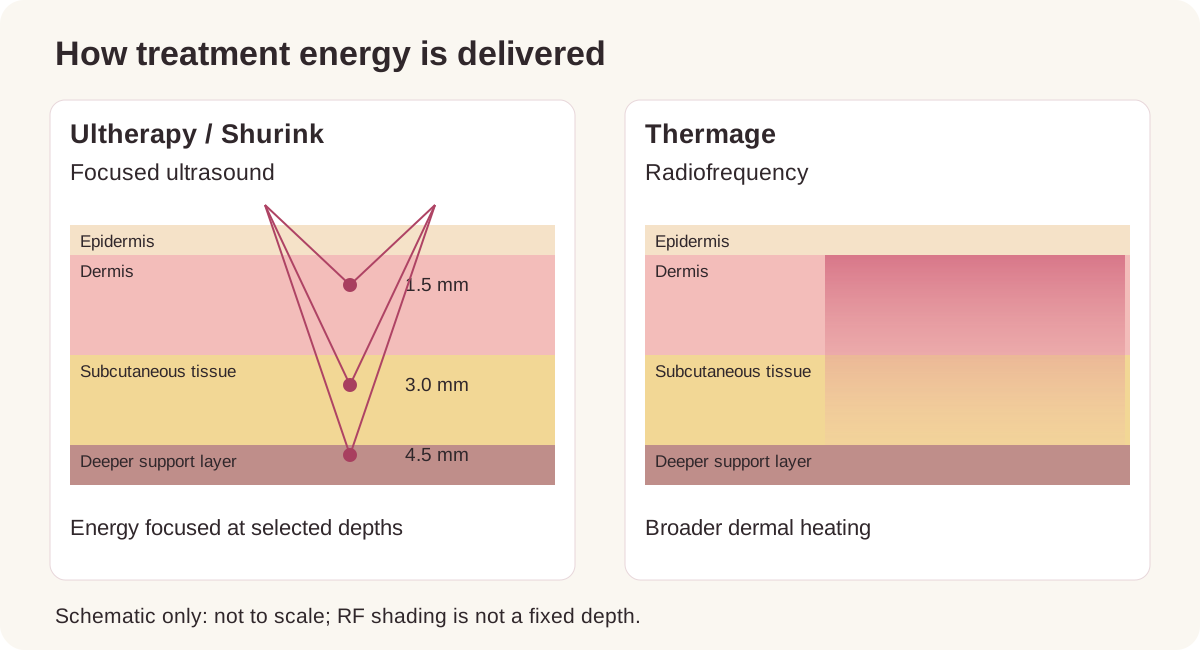
| Device | Energy and depth | Manufacturer or regulatory guidance |
|---|---|---|
| Ultherapy | Focused ultrasound, 1.5, 3.0 and 4.5 mm | Brow, lax jawline and upper-chest lifting, among other listed purposes |
| Thermage | Radiofrequency, broad dermal heating | US guidance includes wrinkles and periorbital wrinkles |
| Shurink Universe | Focused ultrasound, facial cartridges at 1.5, 2.0, 3.0 and 4.5 mm | Tissue coagulation for brow lifting |
Ultherapy and Shurink guidance here comes from Merz Korea and Classys Korean product information. Thermage guidance comes from US manufacturer and FDA documents. Concerns discussed in a clinic and a device's regulatory indications are separate items.
How did reviewers' concerns differ?
Sagging and jawline concerns were common in Ultherapy and Shurink reviews; firmness and fine lines were common in Thermage reviews. A post could mention several concerns.
| Concern in reviews | Ultherapy: 398 | Thermage: 396 | Shurink: 398 |
|---|---|---|---|
| Contours, including sagging and jawline | 268 / 67% | 142 / 36% | 224 / 56% |
| Skin concerns, including firmness and fine lines | 92 / 23% | 225 / 57% | 51 / 13% |
| Double chin | 69 / 17% | 8 / 2% | 62 / 16% |
Ultherapy reviews mentioned a less defined jawline and descending cheeks; Shurink reviews mentioned sagging and double-chin concerns. Thermage reviews also mentioned texture and the eye area.
Reasons for choosing treatment included clinic advice, price and reviews or reputation. Among 408 sentences describing selection reasons, clinic recommendations appeared in 154, price in 71, and reviews or reputation in 65. Describing concerns and discussing a proposed treatment plan were part of the choice.
What did reviews say about pain and anesthesia?
About half of pain-related reviews described treatment as tolerable. All three also had reports of substantial pain.
| Pain description | Ultherapy: 155 | Thermage: 119 | Shurink: 121 |
|---|---|---|---|
| Quite painful | 16 / 10% | 15 / 13% | 21 / 17% |
| Tolerable | 93 / 60% | 67 / 56% | 60 / 50% |
| Almost painless | 46 / 30% | 37 / 31% | 40 / 33% |
Among posts mentioning anesthesia, sedation appeared in 32% for Ultherapy, 54% for Thermage and 5% for Shurink; numbing cream appeared in 45%, 25% and 62%, respectively. Discuss the area, shot count and anesthesia when asking about pain. For sedation, also ask about responsible staff, monitoring and instructions for going home after recovery.
Were swelling, bruising or cheek hollowness reported?
Posts described swelling and bruising, as well as worries about or experiences of cheek hollowness. Counts mentioning each experience are below.
| Experience | Ultherapy: 398 | Thermage: 396 | Shurink: 398 |
|---|---|---|---|
| Swelling | 31 | 15 | 15 |
| Bruising | 6 | 2 | 4 |
| Worried about cheek hollowness | 16 | 4 | 8 |
| Experienced cheek hollowness | 1 | 1 | 4 |
| Immediate return to daily activities | 28 | 28 | 24 |
Treatment areas and settings varied between reviews, and some included concurrent procedures. Discuss time for swelling and bruising to settle before an important event. Point out areas with little facial fat or existing hollowness during assessment.
When were effects noticed, and how long do they last?
Reviews that mentioned timing described changes both on the same day and weeks later. Same-day changes were common in Shurink posts, while 1 week to 1 month was more common for Ultherapy and Thermage.
| Perceived onset | Ultherapy: 106 | Thermage: 87 | Shurink: 67 |
|---|---|---|---|
| Same day | 34% | 26% | 78% |
| 1–2 weeks | 34% | 36% | 18% |
| 3 weeks–1 month | 26% | 29% | 3% |
| 2–3 months | 6% | 9% | 1% |
An Ultherapy expert consensus describes collagen remodeling, changes over several months and repeat-treatment planning at 12–18-month intervals. The Thermage manufacturer describes changes visible immediately, improvement over 6 months and annual maintenance. A Shurink Universe eye-area study followed 34 Korean women for 12 weeks, with 76% reporting improvement. Study observation periods and repeat-treatment intervals describe different things.
What did research comparing ultrasound and radiofrequency find?
A split-face study found improved laxity on both treated sides. The 2019 study followed 20 people with mild to moderate laxity for 6 months.
One facial side received microfocused ultrasound with visualization and the other monopolar radiofrequency. Laxity scores improved from Day 30 and remained improved at Day 180. Differences between modalities in improvement, satisfaction and adverse events were not statistically significant. The comparison concerns energy modalities; device brands are unspecified in the abstract.
A 2015 tissue study found increased collagen across several dermal layers after radiofrequency, while focused ultrasound showed increases in the middle and deep layers. This supports the explanation of different energy-delivery patterns.
Are treatments combined for sagging and reduced firmness?
Ultrasound and radiofrequency are sometimes used together. Same-day Ultherapy and Thermage treatment was mentioned in 13 Ultherapy reviews and 27 Thermage reviews.
A 2024 retrospective study of 56 people reported improvement in 96.4% after combined treatment, with temporary redness the common reaction. It reviewed one clinic's records without a control group. Ask which modality is used in each area, whether sessions are on the same day or separated, and the total cost.
What should people with little facial fat discuss first?
Explain existing hollows and the areas where you want to preserve volume. Of 25 selection-related sentences mentioning little facial fat, 17 chose Thermage, 3 Ultherapy and 2 Shurink.
A survey of 13 Korean dermatologists also described preferences for volume injections or microneedle radiofrequency in patients with less facial fat. When hollowness is the main concern, discuss volume correction; when sagging is also present, plan separately by area.
Which health conditions should be disclosed?
Tell the clinician about implanted electronic devices, pregnancy or breastfeeding, and prior procedures. Thermage lists implanted electronic devices as contraindications. Ultherapy instructions also list implanted electronic devices, wounds, severe acne and metal implants in the treatment area.
For fillers, fat grafting, threads or surgery, state the areas and dates. Diabetes, autoimmune disease and medications also need assessment. Contact the treating clinic for blisters, burns, worsening pain or altered sensation after treatment.
Which treatment should be discussed for different concerns?
Start with whether sagging or fine lines are the main concern. Facial fat and prior treatment history are assessed before choosing energy type and scope.
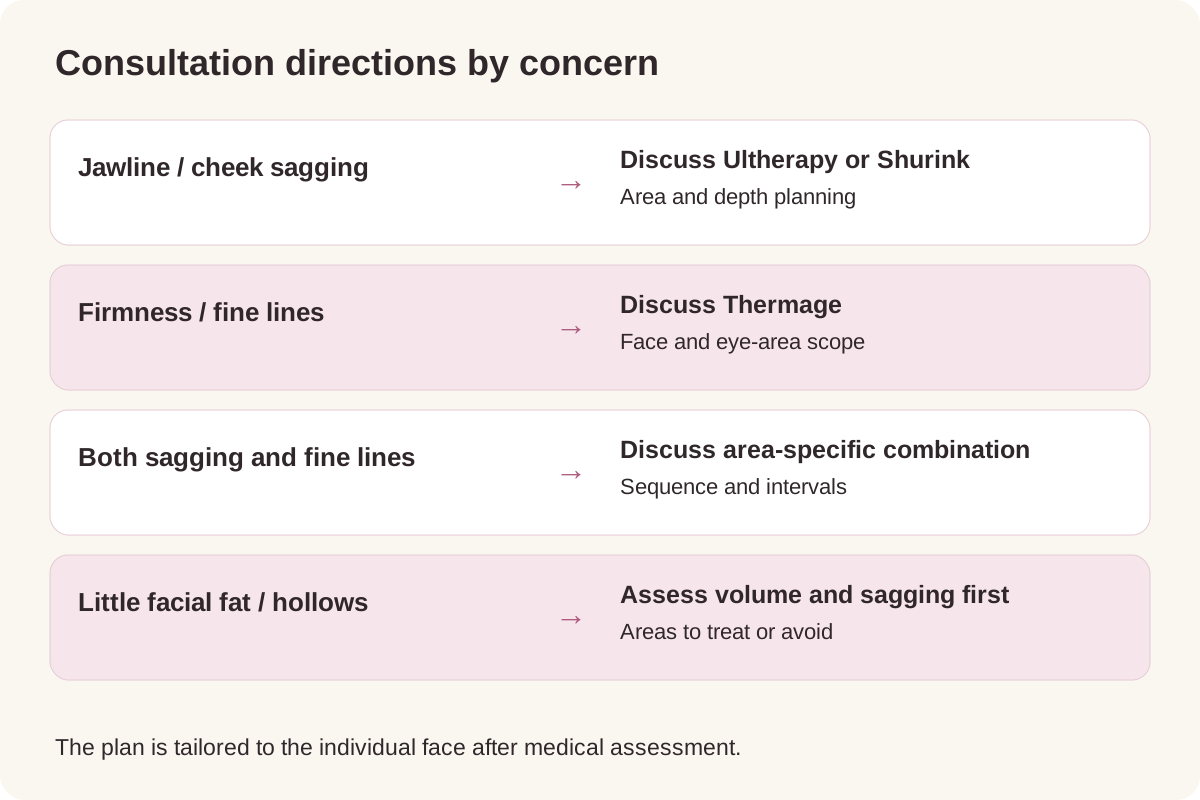
| Concern | Consultation focus |
|---|---|
| Descending jawline and cheeks with sufficient facial fat | Ultherapy or Shurink treatment area and depth |
| Reduced firmness and fine lines | Thermage scope and whether a separate eye tip is used |
| Sagging and fine lines together | Area-specific combination goals, sequence and intervals |
| Little facial fat and hollow areas | Assessment of hollowness and sagging, areas to treat or avoid |
For dose planning, compare area allocation and package details in the guides to Ultherapy 300 vs 600 shots, Thermage 300 vs 600 shots and Shurink Universe 300 vs 600 shots.
What should I ask when comparing consultations and prices?
- Is the main problem sagging tissue or reduced skin firmness?
- Which areas will be treated, and how will existing hollows be handled?
- Will the clinician who consults me perform treatment?
- What anesthesia is used, and who monitors sedation?
- Does the total include VAT, anesthesia and follow-up?
- Will prior fillers or surgery affect the treatment area?
Compare the device model, shot count, inclusion of face, eye area or neck, and anesthesia cost. First-visit and limited-period conditions also affect the final amount.
Conclusion
Ultherapy and Shurink use focused ultrasound, while Thermage uses radiofrequency. Reviewers described contour and skin-firmness concerns, with varied pain and swelling experiences even within the same treatment. Discuss desired changes, facial fat and prior procedures before defining scope.
After device selection, discuss shot allocation, anesthesia and total cost. If two procedures are proposed, ask about each one's purpose and area, their sequence and recovery timing.
Frequently Asked Questions
How do Ultherapy, Thermage and Shurink differ?
Ultherapy and Shurink concentrate ultrasound at selected depths, while Thermage heats the dermis using radiofrequency. Selection follows assessment of desired changes, facial fat and the treatment area.
What should I discuss for a sagging jawline or cheeks?
Discuss the scope and depth of Ultherapy or Shurink. Point out any already hollow cheek areas as well.
Is Thermage discussed for firmness and fine lines?
Thermage reviews often mentioned firmness and fine lines, and US documents list wrinkles and periorbital wrinkles. Ask separately about facial and eye-area packages.
What did pain reviews describe?
Tolerable pain was described in 60% of pain-related Ultherapy reviews, 56% for Thermage and 50% for Shurink. Experiences varied with anesthesia and area.
Can swelling and bruising occur?
All three had reviews describing swelling and bruising. Discuss recovery before important events, and report worsening pain or blisters to the clinic.
Are Ultherapy and Thermage sometimes combined?
Some reviews described both on the same day. Area-specific goals, sequence, intervals and total cost are decided during consultation.
How should someone with little facial fat choose?
Explain existing hollows and areas where volume should be preserved. Planning may separate volume correction from treatment of sagging.
Are effect onset and repeat-treatment intervals the same?
Onset is when changes begin to be noticed; a repeat-treatment interval is the planned gap before another session. Follow-up uses manufacturer guidance, study observation periods and current skin condition.
Sources and verification dates
- Merz Korea Ultherapy PrimeOctober 22, 2026; Korean product information and indications.
- Classys Shurink UniverseOctober 22, 2026; facial cartridges and Korean indications.
- Thermage US professional informationOctober 22, 2026; effects, contraindications and adverse reactions.
- FDA K170758US Thermage FLX document.
- Ulthera System instructionsexclusions and precautions.
- Alhaddad et al., 2019, PMID 30531187randomized split-face study, 20 people, 6 months; abstract only, device brands unspecified.
- Suh et al., 2015, PMID 25723905dermal tissue examination 2 months after treatment.
- Khong et al., 2024, PMID 38456105retrospective combined-treatment study, 56 people, no control group.
- Oh et al., 2025, PMID 40432360preference survey of 13 Korean dermatologists.
- Ultherapy expert consensus, PMID 34188753treatment course and repeat-session planning; manufacturer advisory relationships disclosed for some authors.
- Ultraformer MPT eye-area study, PMID 4143887934 Korean women followed for 12 weeks.
- Gangnam Unni and Babitalk, October 22, 2026: collection pool of 18,223 posts; 400 sampled per device, with 398, 396 and 398 post-treatment reviews. Pain, anesthesia and onset denominators include only posts mentioning each item. Self-posted reviews and concurrent procedures included; cross-platform duplication unresolved. Comparison/selection sentence set: 1,069. Original text and user names omitted.
Editorial responsibilities and relationships
Written by the DermaFocus Editorial Team; not medically reviewed. No advertising, contractual, partnership or financial relationship with the manufacturers mentioned. Individual diagnosis and treatment planning take place during medical care.