
Key Summary
Laser treatment improves rough texture around scars and stimulates collagen remodeling. Subcision releases fibrous tissue pulling a scar downward, while filler adds volume to reduce the height difference. When several scar shapes occur on one face, different areas may need different treatments. Narrow, deep ice-pick scars are also treated with TCA CROSS, which applies acid locally, or punch excision, which removes an individual scar with a small instrument.
Reviewers describe smoother skin after repeated treatment as well as disappointment with small changes. They also mention bruising after subcision and stinging or flaking after laser treatment. The appearance after swelling settles differs from scar changes assessed months later. Treatment aims to reduce scar depth and shadowing. Filler longevity and the number of sessions depend on the product and the scars being treated.
How are depressed scars classified by shape?
Depressed scars include broad, gently sloping rolling scars, sharply edged boxcar scars, and narrow, deep ice-pick scars. Several types can occur on the same cheek. An acne-scar classification study describes selecting subcision, laser resurfacing, punch excision or punch elevation according to scar shape.
| Scar shape | Features | Treatment to discuss |
|---|---|---|
| Rolling | Broad, wave-like depressions, sometimes pulled down by fibrous tissue | Examination for tethering before considering subcision |
| Shallow boxcar | Defined edges with a relatively shallow base | Fractional laser or microneedle radiofrequency |
| Deep boxcar | Defined edges with a deeper depression | Treatment of individual scars, such as punch elevation or excision |
| Ice-pick | A narrow opening extending deeply into the skin | TCA CROSS or punch excision |
Red or brown marks involve color, while depressed scars involve a change in skin height. Both can need treatment when they occur together. The guide to acne scars and red marks explains the distinction.
What do laser, subcision and filler each do?
Laser uses heat to stimulate remodeling, subcision releases tethering tissue, and filler adds missing volume. Devices such as Potenza deliver radiofrequency through needle tips and work differently from lasers.
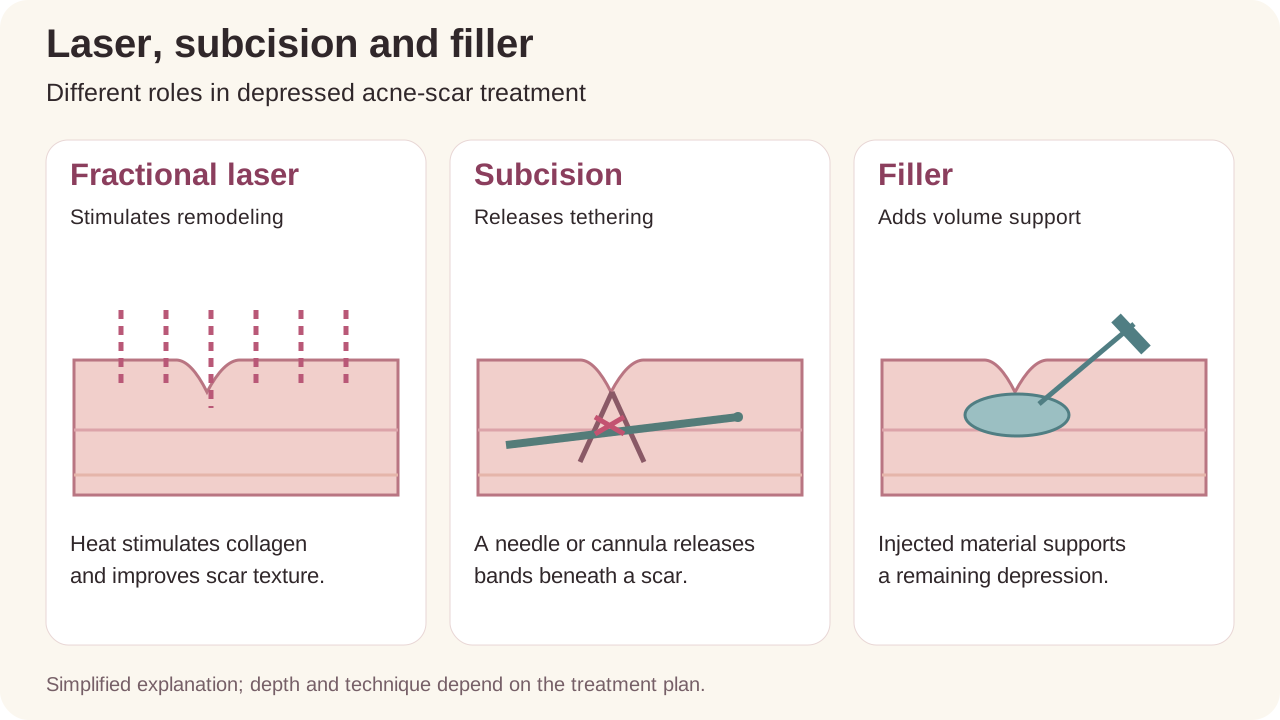
| Treatment | What it does | Main burdens |
|---|---|---|
| Fractional laser | Creates small, spaced treatment zones to improve scars and texture | Stinging, redness, crusting and pigmentation |
| Subcision | Uses a needle or blunt cannula to separate tethering beneath a scar | Pain, bruising, swelling, a collection of blood or a lump |
| Filler | Injects material into a depression to add support | Swelling, lumps, asymmetry and, rarely, blockage of a blood vessel |
Able Dermatology Clinic describes releasing tethering in rolling scars before combining filler with energy-based treatment. The reason for the depression is examined before adding volume.
What changes and discomfort do reviewers describe?
Some reviewers describe smoother skin, while others are still unsure about the change. Their session counts and additional treatments differ.
Babitalk, Fraxel review 6874177, treatment date December 11, 2024, short excerpt, review search
1회만으로는 크게 효과 없을 수 있다해서 꾸준히 5회정도하니 확실히 많이 매끈해졌어요ㅎㅎ
English translation: I was told one session might not make a big difference, and after keeping it up for about five sessions, my skin has definitely become much smoother, haha.
Babitalk, Fraxel review 8082562, treatment date October 2, 2026, short excerpt, review search
다만 그만큼 효과가 있는지는 좀 지켜봐야할거 같아요
English translation: But I think I need to wait a little to see whether it is that effective.
Gangnam Unni, combined subcision and Juvelook review, July 2026 displayed, short excerpt, review search
서브시전 멍이 좀 오래 가네요.
English translation: The bruising from subcision is lasting a bit long.
Some people are satisfied after repeated treatment, while others are waiting to assess the result. The reviewer who combined subcision and Juvelook described bruising as a burden. These excerpts come from three different users and are unrelated to the clinic case in this article.
Collagen-stimulating injections such as Juvelook differ from hyaluronic acid fillers. A review listing combined treatments does not make them the same product or procedure. The Juvelook Skin and Volume guide explains their ingredients and product differences.
Which scars are treated with subcision, and when is the result assessed?
Subcision treats broad rolling scars pulled down by tissue beneath the skin. This attachment is called tethering. Serene Clinic and Yonsei Star Dermatology describe releasing it before proceeding with other treatment.
A rolling-scar study in which 20 participants completed treatment and follow-up reported mild improvement in about 60% and moderate improvement in about 40%. These percentages describe how participants were grouped by improvement, rather than removal of 60% or 40% of their scars. Subcision study
Able Dermatology Clinic lists 2–4 subcision sessions. Serene Clinic describes intervals of at least 4 weeks and assessing change after about 3 months. Swelling immediately after treatment can make depressions appear more filled than the eventual result.
Which scars respond to laser, and how many sessions are used?
Laser is used for shallow boxcar scars and rough texture; deeper tethering may also require subcision. In a fractional CO2 laser study, rolling and shallow boxcar scars responded better than narrow, deep scars.
The study treated 60 participants with 3–4 sessions at 6-week intervals and assessed them 6 months after the final session. Twenty-six participants were graded as having more than 50% improvement in scar appearance and skin texture; the remaining 34 had smaller improvements. This was a course of treatment followed over time, rather than one session making every scar smooth. Fractional CO2 laser study
| Clinic's published treatment | Sessions and spacing | Recovery guidance |
|---|---|---|
| Reberry Clinic, Potenza | 3–5 sessions, 4–6 weeks apart | 2–4 days |
| Reberry Clinic, CO2 laser | 1–3 sessions, 6–8 weeks apart | 5–10 days |
| Serene Clinic, scar treatment | Repeated treatment at intervals of at least 4 weeks, according to the skin | Redness and swelling for 2–3 days |
Clinic guidance checked October 27, 2026. Serene Clinic's entry describes redness and swelling after its scar treatments, including Potenza.
When asking about Potenza pricing, ask which tip will be used and at what depth. The Potenza guide to pores and scars explains devices and tips.
Can filler be used alone for scars, and how long does it last?
Filler is considered for localized depressions without tethering; when tissue pulls a scar down, subcision is also planned. Widwin Dermatology Clinic describes subcision for rolling scars with filler added when needed.
Filler studies have also reported improvement in depressed scars. Their products and treatment schedules were as follows.
| Product studied | Participants and treatment | Observed result |
|---|---|---|
| A filler containing synthetic PMMA and collagen | 147 participants, up to 2 injections, compared with saline injections | Better scar improvement than saline at the 6-month assessment |
| Hyaluronic acid filler | 12 participants, 3 sessions, 4 weeks apart | Followed for up to 36 weeks, with improvement developing over time |
These studies used different products and assessment conditions. PMMA filler trial, hyaluronic acid filler study
Able Dermatology Clinic lists a duration of 6–18 months depending on the filler. The actual time for retreatment depends on the product, injection site and remaining depression. The studies' 6-month and 36-week periods describe follow-up, rather than the day the treatment stopped working.
How are ice-pick and deep boxcar scars treated?
Narrow, deep scars are treated individually with methods such as TCA CROSS, punch excision or punch elevation. TCA CROSS applies concentrated acid locally inside a scar to stimulate repair. Punch excision removes the scar with a small instrument, while punch elevation raises the depressed base.
| Clinic | Published explanation for boxcar scars |
|---|---|
| Yonsei Star Dermatology | Non-sutured punch treatment for 1–5 mm boxcar scars |
| Able Dermatology Clinic | Fractional CO2 laser and microneedle radiofrequency |
| Serene Clinic | Potenza for box-shaped and shallow scars |
Boxcar scars range from shallow to deep, so the same name can lead to different plans. An individual deep scar may be treated first, with laser then used for surrounding rough texture. Reberry Clinic also describes using CO2 laser to refine the openings of ice-pick scars and adding other treatment for deeper depressions. Ask about crusting and pigmentation after TCA CROSS and a small new scar after punch treatment.
In what order are combined treatments performed?
Tethered areas are released with subcision, with filler or laser added according to the remaining depression and texture. Able Dermatology Clinic describes subcision, filler and energy-based treatment in that order. Serene Clinic describes starting with subcision for rolling scars.
A split-face trial comparing subcision plus CO2 laser on one side with laser alone on the other found better scar-improvement assessments on the combined side. Bruising occurred only on the combined side and lasted 1–2 weeks. Subcision and laser combination trial
Treatments can be scheduled together or on separate dates. Able Dermatology Clinic describes injecting filler immediately after subcision. Ask why each treatment is being added and what bruising and swelling to expect if they are performed on the same day.
How long do bruising and redness last, and why does pigmentation occur?
Bruising and swelling are major recovery burdens after subcision; redness and crusting are common burdens after laser. A study comparing needle and cannula subcision also reported bruising, lumps and swelling. Subcision technique comparison
| Clinic or study | Symptoms and periods described |
|---|---|
| Able Dermatology Clinic | Bruising and swelling for 5–10 days after subcision |
| Yonsei Star Dermatology | Describes immediate return to daily activities after subcision, with bruising for 1–2 weeks |
| Dermia Clinic | Describes substantial bruising, plus redness, dryness and flaking over 3–4 weeks after subcision |
| CO2 laser study with 60 participants | Redness averaged 3–4 days and crusting 4–6 days; 3 participants had pigmentation lasting 8–12 weeks |
Clinic guidance and study findings checked October 27, 2026. Bruising, redness and dryness settle at different rates.
Being comfortable enough to return to work differs from all bruising and redness disappearing. Tell the clinician about an upcoming event or photographs. Ask separately how long visible marks may remain and when makeup is allowed.
A study of nonablative fractional laser in 47 Asian patients found less pigmentation when treatment density was reduced and sessions were increased, compared with denser treatment. Skin color, previous pigmentation, density and intensity matter alongside the device name. During recovery, moisturize, protect against sunlight and let crusts fall off naturally. Asian fractional laser study
Filler rarely causes blockage of a blood vessel, with potential skin injury or vision damage. Seek immediate medical care for unusual severe pain, skin turning white, gray or blue, or changes in vision during or shortly after injection. US FDA filler safety information
What does an actual case published by a clinic describe?
Mellow Dermatology Clinic published a case of a man in his twenties treated with Secret RF and Potenza for scars and enlarged pores on his cheeks and jawline. Several scar shapes were present, making the skin look uneven.
Both devices deliver radiofrequency through fine needles to treat scars and pores. The clinic describes reduced scarring and smoother texture after treatment. It does not give the total session count, spacing or a measured reduction in scars. The treatments used in this case were Secret RF and Potenza. Mellow Dermatology Clinic case
Treatment depends on whether enlarged pores and shallow scars occur together, as in this case, or whether deeper tethering is the main issue. Ask, “Which areas can be treated with radiofrequency alone, and which need tethering released separately?”
What if acne is still active, or the scars are raised?
Significant new inflammation is treated first, while raised scars require a different approach from depressed scars. Serene Clinic describes treating mild acne alongside scars but first stabilizing significant inflammation. The FDA also advises delaying filler in inflamed or infected skin until that condition is managed.
Tell the clinician if you have developed keloids or thick, raised scars and describe how previous wounds healed. If you take isotretinoin or recently stopped it, provide the medication name and last dose date. Decide on the procedure and timing with the treating physician in light of your medication history.
What should be compared when checking scar-treatment prices?
Prices labeled “subcision” can cover different areas, injections and lasers. Compare the full plan for your scars and the included costs, rather than only the lowest single-session price.
| Item | Questions to ask when requesting a quote |
|---|---|
| Area | Individual scars, the whole cheek, or the full face? |
| Treatments included | Subcision alone, or additional laser or injections? |
| Sessions and spacing | One session or a package, and how long until the next treatment? |
| Injection product | Hyaluronic acid or a collagen-stimulating product; what product and volume? |
| Extra costs | Are anesthesia, soothing care and VAT included, and what are the promotional conditions? |
| Later treatment | What are the prices and top-up terms if further treatment is needed? |
What should I discuss for my own scar pattern?
The clinician examines how scars change when skin is stretched sideways, along with their depth and edges. Depressions are not all treated alike based on appearance alone.
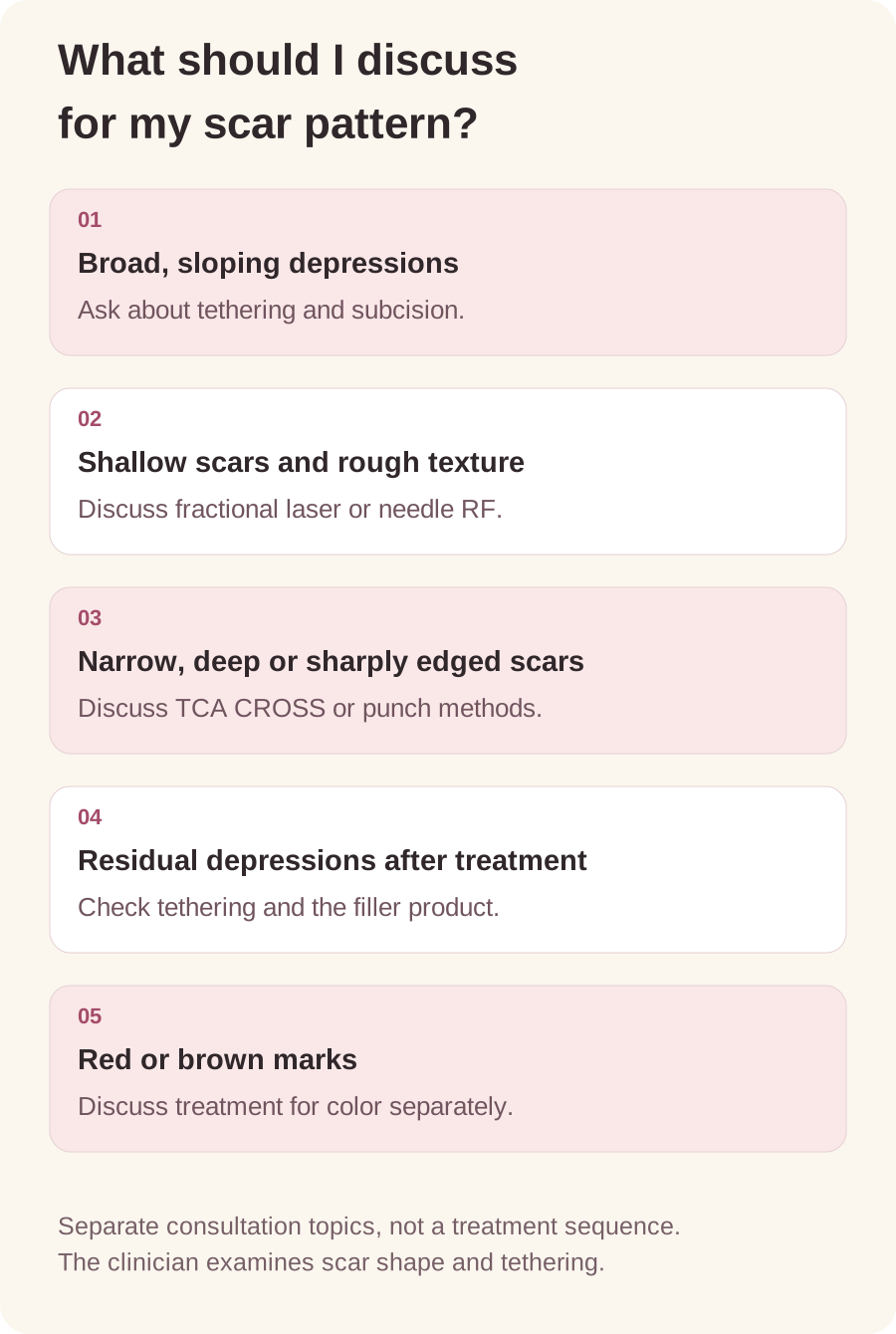
| Concern | What to discuss |
|---|---|
| Broad depressions that flatten when the skin is stretched | Tethering and the areas needing subcision |
| Shallow depressions, rough texture and visible pores | Type and settings of fractional laser or microneedle radiofrequency |
| Narrow, deep scars or deep, defined edges | Where TCA CROSS or punch treatment would be used, and the risk of a new scar |
| Localized depressions remaining after previous treatment | Remaining tethering and the reason to add filler or another injection |
| Red or brown marks are more bothersome | Whether pigment or vascular treatment is also needed |
What questions should I ask during consultation?
- Which scar types are present, and where is there tethering?
- Why is each treatment being used, and which comes first or later?
- After how many sessions will we assess change, and when would we adjust the plan?
- How will settings and spacing be chosen to reduce pigmentation risk in my skin?
- How much bruising or crusting may remain before my event, and when can I wear makeup?
- Will the doctor who consults with me perform the treatment? Whom do I contact if a problem develops afterward?
Conclusion
If deep depressions remain after repeated laser treatment, ask whether tethering needs release or individual scars need separate treatment. When considering filler, discuss the product, the areas to be filled and expected longevity. Look for a plan explaining the treatments your scars need and the recovery expected from each.
Frequently Asked Questions
Which comes first for depressed scars: laser, subcision or filler?
Subcision is considered first in tethered areas; shallow scars and rough texture are treated with laser or microneedle radiofrequency. Narrow, deep scars may be treated separately with TCA CROSS or punch techniques. When shapes are mixed, the order is planned by area.
Does subcision work?
Improvement has been reported in rolling scars pulled down by fibrous tissue. When deep depressions and rough texture coexist, laser or injections may also be planned. Changes are assessed over several weeks after swelling settles.
How long does scar filler last?
It depends on the product and injection site. Able Dermatology Clinic lists 6–18 months depending on the filler. Study follow-up and an individual's actual retreatment date differ, so ask about the chosen product's expected duration and top-up plan.
Is filler injected on the same day as subcision?
Same-day injection is one approach. Able Dermatology Clinic describes injecting filler immediately after subcision. Timing and recovery depend on the product and amount needed and whether laser is also performed.
Is subcision used for ice-pick scars?
TCA CROSS or punch excision is usually considered for narrow, deep ice-pick scars. If rolling scars and tethering coexist nearby, subcision can be used separately in those areas.
How long does bruising last after subcision?
Able Dermatology Clinic lists 5–10 days; Yonsei Star Dermatology describes 1–2 weeks. Recovery also changes with the area and additional treatments. Discuss important dates together with the proposed treatment extent.
What should I do if I am worried about pigmentation after laser?
Tell the clinician about any previous post-laser pigmentation. Discuss approaches such as reducing treatment density and spreading treatment over more sessions. Afterward, use sun protection and moisturizer and avoid picking crusts.
How many sessions are needed for scar treatment?
The number depends on scar depth, area and the treatment combination. Ask when progress will be assessed and how remaining scars will be treated, rather than matching a listed session count alone. The appearance while swollen immediately after the first session differs from the final result.
Sources and verification dates
- Able Dermatology Clinic: subcision and filler comparison(original checked 2026-10-27): tethering, combined-treatment order, 2–4 subcision sessions, bruising for 5–10 days and filler duration of 6–18 months
- Serene Clinic: treatment by acne-scar type(original checked 2026-10-27): scar types, intervals of at least 4 weeks, assessment after about 3 months and active acne
- Yonsei Star Dermatology: non-sutured punch and subcision(original checked 2026-10-27): 1–5 mm boxcar scars, rolling-scar tethering, bruising and daily activities
- Reberry Clinic: types of acne-scar treatment(original checked 2026-10-27): intervals, session counts and recovery for Potenza and CO2 laser
- Widwin Dermatology Clinic: acne scars(original checked 2026-10-27): subcision with filler, punch excision and CROSS
- Dermia Clinic: subcision(original checked 2026-10-27): bruising, redness, dryness, flaking and 3–4 week recovery guidance
- Mellow Dermatology Clinic: scars and pores in a man in his twenties(original checked 2026-10-27): combined Secret RF and Potenza, initial condition and clinic-described outcome
- Acne-scar classification, J Am Acad Dermatol 2001, PMID 11423843(2026-10-27): rolling, boxcar and ice-pick classification and treatment methods
- Subcision clinical trial, J Eur Acad Dermatol Venereol 2008, PMID 18341538(2026-10-27): 22 enrolled, 20 completed; mild improvement in about 60% and moderate improvement in about 40%
- Fractional CO2 laser study, J Cutan Aesthet Surg 2014, PMID 25136208(2026-10-27): 60 participants, 3–4 sessions 6 weeks apart, assessment 6 months after the last session; 26 graded as more than 50% improved, pigmentation in 3
- Nonablative fractional laser in Asian patients, Lasers Surg Med 2010, PMID 21246574(2026-10-27): retrospective study of 47 patients comparing pigmentation with different treatment densities and session counts
- PMMA-collagen filler trial, J Am Acad Dermatol 2014, PMID 24725475(2026-10-27): 147 participants, randomized comparison; 64% met the improvement criterion at 6 months versus 33% with saline
- Hyaluronic acid filler study, Dermatol Surg 2018, PMID 30358630(2026-10-27): 12 participants, 3 sessions 4 weeks apart, follow-up through 36 weeks
- Subcision and CO2 laser combination trial, Adv Biomed Res 2017, PMID 28349023(2026-10-27): split-face comparison, better improvement assessments with combination treatment; bruising for 1–2 weeks
- Needle and cannula subcision comparison, J Cosmet Dermatol 2019, PMID 29524284(2026-10-27): 34 participants, split-face comparison, bruising, lumps and swelling reported
- US FDA filler safety information(2026-10-27): product-dependent duration, delaying injections in inflamed skin, vascular complications and symptoms requiring immediate medical attention
- Babitalk acne-scar reviews(2026-10-27): excerpts from reviews 6874177 and 8082562; dates are displayed treatment dates
- Gangnam Unni subcision reviews(2026-10-27): excerpt describing bruising after combined subcision and Juvelook; July 2026 displayed
Editorial responsibility and relationships
Written by the DermaFocus Editorial Team without medical review. Clinic cases are clinics' published descriptions; reviews are individual users' experiences. Short excerpts are reproduced verbatim without usernames or photographs, with English translations added. DermaFocus has no advertising, contractual or affiliate relationship with the clinics mentioned and received no payment or sponsorship. Diagnosis and treatment planning require examination.