
Key Summary
Inner-corner surgery releases a skin fold covering the inner corner. Outer-corner surgery changes the length and shape at the outer corner. Ptosis correction adjusts how the upper eyelid lifts. If the upper lid covers much of the iris and makes the eye look sleepy, eyelid function is examined first. When loose skin covers the eye, removing skin and creating an eyelid crease may address the problem instead.
Reviewers described longer-looking eyes or easier opening, as well as swelling remaining after a month and outer corners adhering again. Discuss inner-corner scarring and excessive exposure, outer-corner reattachment and shape changes, and insufficient or excessive upper-lid elevation. Combining operations should follow an explanation of what each would change.
What does each operation change?
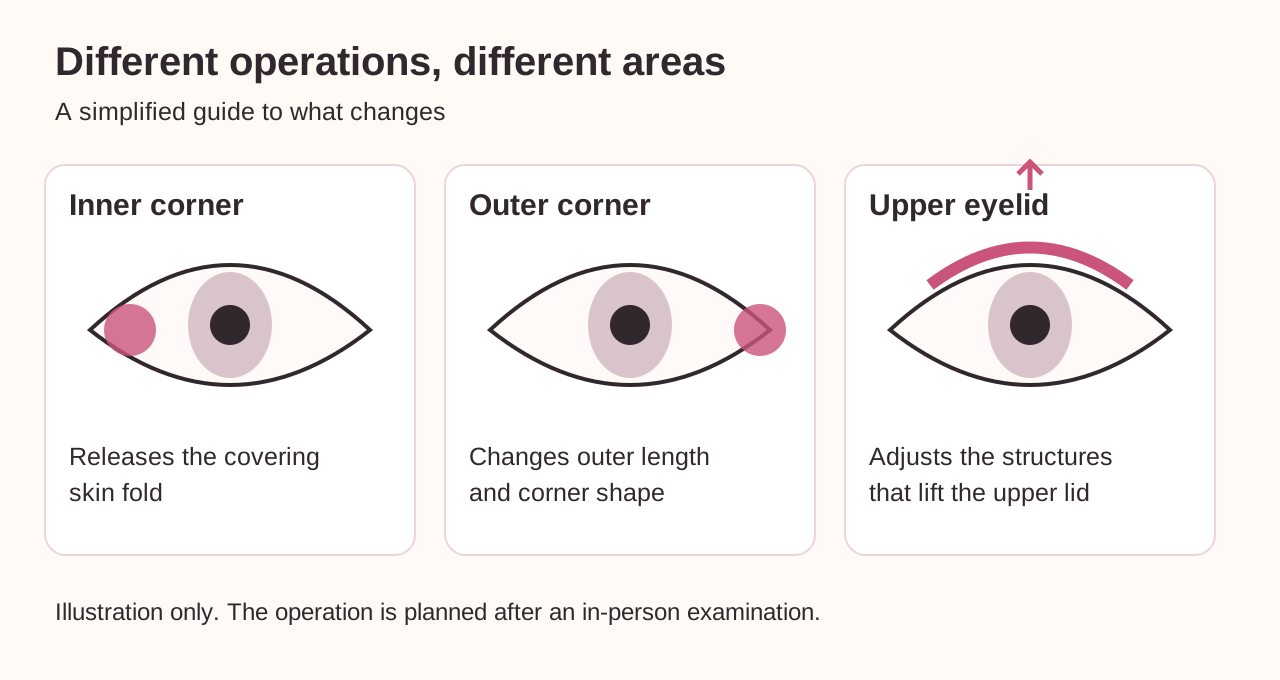
Corner operations change the ends of the eye opening; ptosis correction changes the upper eyelid's height. They work on different areas despite being grouped as eye-enlargement procedures.
| Operation | Area changed | What to discuss |
|---|---|---|
| Inner-corner surgery | The epicanthal skin fold covering the inner corner | Distance between the eyes and exposure of the pink inner-corner tissue |
| Outer-corner surgery | Length and shape at the outer corner | Available space, corner angle and lower-eyelid condition |
| Ptosis correction | Muscles and connecting tissue that lift the upper lid | Eyelid movement and differences between sides |
JK Plastic Surgery distinguishes an inner corner covered by skin from a short outer eye opening. The Swan Plastic Surgery explains that it measures eyelid height and lifting function before ptosis correction. Corner-surgery explanation, eyelid assessment
Do sleepy-looking eyes need ptosis correction?
First determine whether the upper eyelid is failing to lift fully. Some people have substantial iris coverage when relaxed or raise their eyebrows and forehead to open their eyes. Examination assesses eyelid movement without that assistance.
A forehead-lifting habit alone does not establish the need for surgery. Lifting function can be adequate while loose skin covers the lid. Creating a crease and improving eyelid elevation address different issues. The Swan Plastic Surgery's ptosis explanation
One Gangnam Unni reviewer who combined natural-adhesion double-eyelid surgery with ptosis correction described using the forehead less.
Gangnam Unni, double-eyelid surgery with ptosis correction, written January 2026
눈 뜰 때 이마에 힘이 안 들어가요!!
English translation: I no longer tense my forehead when I open my eyes!!
Source: Gangnam Unni ptosis-search reviews. A short excerpt.
The photographs were labeled postoperative day one, so this describes an early experience. The reviewer is a different person from the clinic case below.
A clinic also describes a patient treated without ptosis correction. In a case published by Lisoom Plastic Surgery in May 2022, a woman in her twenties had loose skin covering her eyes. The clinic describes lifting the skin to examine the underlying lid position, then removing skin and creating a crease without ptosis correction. It presents greater visibility of the previously covered eye after surgery. Lisoom Plastic Surgery case explanation
Ask, “Is my eyelid failing to lift, or is skin covering it?” Similar sleepy appearances can require different operations.
How are inner- and outer-corner surgery selected?
A covering inner-corner fold prompts discussion of inner-corner surgery; outer length and corner shape prompt discussion of outer-corner surgery. Opening the inner corner exposes more tissue, so the extent needs particular care when the eyes are already close together. Outer-corner extension also depends on the available space.
Distinguish outer-corner lengthening from lowering the outer lower lid. The first changes outer length; the second adjusts the shape and height below the corner. If a clinic packages them together, ask what each component changes. JK Plastic Surgery's descriptions
One Babitalk reviewer described noticing a change at the outer corners as swelling subsided after combined lengthening and lowering.
Babitalk, combined outer-corner lengthening and lowering
눈 뒤쪽이 자연스럽게 길어진 게 보여서 만족스러웠어요.
English translation: I was pleased to see the outer part of my eyes looking naturally longer.
Source: Babitalk outer-corner surgery reviews. A short excerpt; posting and procedure dates were not displayed.
The writer also described pain during stitch removal. Because both procedures were performed, ask about the scope and recovery of each.
How do incisional and non-incisional ptosis correction differ?
Non-incisional correction works internally without a long skin incision; incisional correction opens the skin to adjust the underlying tissue. Incision is considered when loose skin needs removal or the eyelid is thick. Thin skin and a smaller correction may suit a non-incisional approach.
Lisoom Plastic Surgery describes skin thickness and lifting function as selection factors. Ask whether skin needs removal and how much correction is planned rather than inferring recovery or scarring from the term “non-incisional.” Lisoom Plastic Surgery's method explanation
Tell the surgeon if you do not want a visible double-eyelid crease. The same clinic article includes correction performed while keeping the crease out of view.
Must corner surgery and ptosis correction be combined?
They are combined when there is a reason to change both horizontal opening and lid height. A covered inner corner does not itself establish a need for ptosis correction. An upper lid that lifts poorly does not itself establish a need for outer-corner surgery.
A case published by Sisun Plastic Surgery in February 2020 described weak eyelid lifting, a covered inner corner and upturned outer corners. The clinic combined non-incisional ptosis correction, a buried-suture crease, limited upper-inner-corner release, outer-corner lengthening and lowering. It describes limiting the inner release because the distance between the eyes was not generous.
Surgery took place on December 31, 2019. At the February 20, 2020 follow-up, the clinic described improvement in the sleepy appearance and crease shape. Residual swelling and surgical marks remained. The combined result does not establish the contribution of each operation separately. Sisun Plastic Surgery's combined case
If combination surgery is proposed, ask, “What will each procedure change? What would remain if I chose only one?” The earlier skin-coverage case illustrates that some eyes do not require ptosis correction.
When does swelling settle, and when can I return to work?
Returning to daily activities and losing all swelling are different milestones. Bruising, swelling and stitch-removal schedules depend on the extent of ptosis correction, corner surgery and crease surgery combined.
Lisoom Plastic Surgery gives general recovery guidance of 5–7 days for non-incisional and 10–14 days for incisional ptosis correction. Asan Medical Center describes about one week to routine activities and around 2–3 months for a double-eyelid result to settle. If corner surgery is added, discuss work leave based on the complete surgical plan. Ptosis-correction recovery guidance, Asan Medical Center's double-eyelid guidance
A Babitalk reviewer wrote more than a month after combined crease surgery, ptosis correction, outer-corner lengthening and lowering. The writer liked the clearer appearance but described morning swelling that decreased later in the day.
Babitalk, combined crease surgery, ptosis correction, outer-corner lengthening and lowering, more than one month afterward
아침에 일어나면 쌍꺼풀라인 아래쪽이 통통 부은 느낌은 있어요
English translation: When I wake up, the area below my eyelid crease still feels puffy.
Source: Babitalk ptosis-correction reviews. A short excerpt; posting and procedure dates were not displayed.
When arranging leave, ask separately about stitch removal, bruising before meeting people, makeup and contact lenses. Explain whether your work involves sustained eye use or face-to-face contact.
What about scars, reattachment and excessive eyelid elevation?
The potential problems depend on the surgical area. Inner-corner concerns include scarring and excessive pink-tissue exposure. Outer-corner concerns include reattachment and shape changes. After ptosis correction, assess insufficient or excessive elevation, asymmetry and eyelid closure.
A Babitalk revision reviewer described the corners rising again after earlier outer-corner lengthening and lowering.
Babitalk, revision after earlier outer-corner lengthening and lowering, revision procedure dated April 2026
눈꼬리도 점점 원래대로 올라가더라고요 ㅠㅠ
English translation: The corners gradually rose back toward their original position, too. ㅠㅠ
Source: A revision account in Babitalk's inner-corner search. A short excerpt.
The writer subsequently described inner-corner surgery and revision of the outer lengthening and lowering at another clinic. This is a different person from the satisfied reviewer above.
A study of 157 patients undergoing ptosis correction also reported insufficient and excessive elevation. It followed patients treated with one particular technique. Ask what lid height is planned and how eyelid closure will be checked. Ptosis-correction follow-up study, PMID 34741757
Report pre-existing dryness or stinging before surgery. Asan Medical Center explains that existing dry-eye symptoms can worsen. If pain, pressure and swelling become severe after surgery, contact the surgical clinic immediately for assessment. Asan Medical Center's precautions
Can an unwanted corner-surgery result be reconstructed?
Reconstruction can address an excessively opened area or a distorted corner. The available skin and scarring determine the scope, and scars or asymmetry may remain afterward.
The Swan Plastic Surgery describes reconstruction consultations for excessive inner pink-tissue exposure, depressed scars, angular outer corners or reattachment. It assesses remaining skin, internal adhesions and scar direction before choosing the surgical scope. The Swan Plastic Surgery's reconstruction explanation
Bring preoperative photographs and explain the date and method of earlier surgery. Examination distinguishes an appearance affected by remaining swelling from scarring or corner distortion that needs treatment.
What should I ask during consultation and when comparing quotes?
Ask why the operation is advised, what it changes, the recovery schedule and additional charges. An examination of opening and closing movement should precede a decision based only on photographs.
- Is my eyelid lifting weak, or is skin covering it?
- How much room is there for inner- or outer-corner extension? How much pink tissue would be exposed?
- Why is each proposed operation needed? What would change if I had only one?
- Why do you advise incision or a non-incisional method? How visible would the crease be?
- How will existing asymmetry and dryness affect the plan?
- Will the consulting surgeon perform the operation and follow-up?
- When are stitch removal, return to work, makeup and contact lenses allowed?
- When and how would insufficient or excessive elevation or reattachment be assessed?
- Does the quote include crease and corner surgery, anesthesia, VAT, medication and follow-up? How are revision fees handled?
Disclose earlier eye surgery, scars and medication. If you take drugs affecting bleeding, such as aspirin or warfarin, the surgeon and prescribing clinician should determine any interruption. Do not stop prescribed medication on your own. Asan Medical Center's preoperative guidance
If ptosis obstructs your visual field, ask about Korean health-insurance eligibility. The Swan Plastic Surgery describes deciding eligibility through visual-field and eyelid-function testing. This does not mean all cosmetic ptosis correction is covered. Ptosis assessment guidance
What should I discuss first for my own eyes?
Describe which area looks covered when relaxed and what you most want to change. The following are consultation prompts rather than a self-diagnostic test.
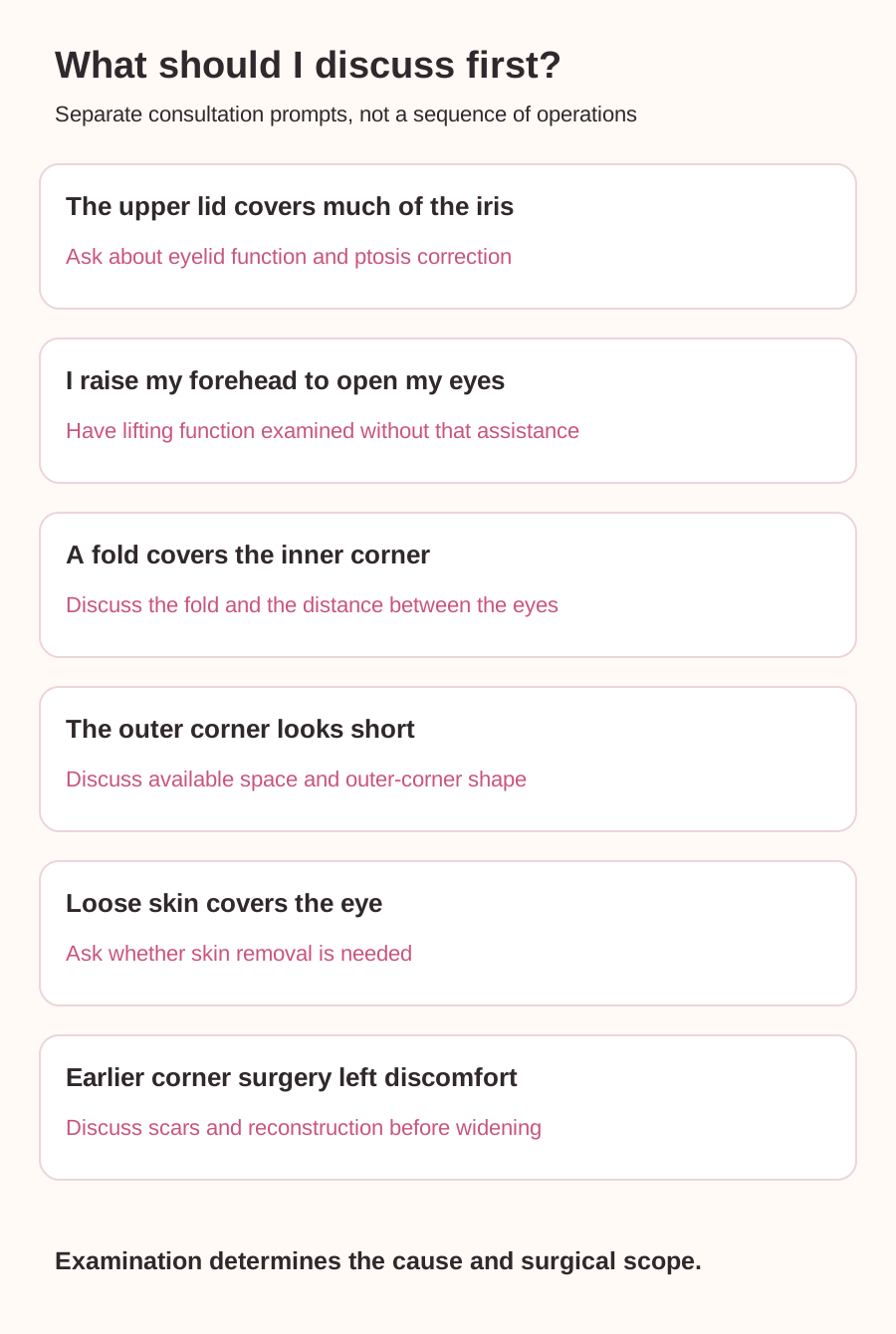
In addition, ask whether loose skin covering the eye needs removal. If correction and corner surgery are both proposed, request the reason for each. If scarring or shape is uncomfortable after earlier corner surgery, seek reconstruction and scar assessment before further widening.
Conclusion
Go beyond “I want bigger eyes”: explain whether the iris looks covered and whether the inner or outer corner feels restrictive. The surgeon should examine opening and closing movement and skin, then explain the area each operation changes and its remaining limitations. If several procedures are proposed, understand why each is needed and agree on recovery and scar considerations before deciding.
Frequently Asked Questions
How do inner- and outer-corner operations differ?
Inner-corner surgery releases the covering skin fold; outer-corner surgery adjusts outer length and shape. The distance between the eyes matters for the former, while available space and lower-lid condition matter for the latter.
Can corner surgery alone correct sleepy-looking eyes?
If poor upper-lid elevation is the cause, eyelid function is examined first. Corner operations change the ends of the eye opening and have a different role from correcting its lifting structures.
Are eye-opening correction and ptosis surgery the same term?
Korean clinics use “eye-opening correction” in a sense that overlaps with ptosis correction. Ptosis describes a drooping upper lid that does not open fully; examination distinguishes this from overlying skin creating a similar appearance.
Can double-eyelid surgery alone change a sleepy appearance?
When skin covers the eye, removing skin and creating a crease can expose the covered area. If lifting function is also weak, examination determines whether that function needs separate correction.
Must ptosis correction and corner surgery be combined?
Combination is discussed when each procedure has something to address. If both are proposed, ask what would remain untreated if either were omitted.
Can the outer corner adhere again after lengthening and lowering?
Reattachment and changes in corner shape can occur. Ask about available space, fixation and the follow-up plan before surgery.
Is non-incisional ptosis correction better than incision?
The choice depends on the amount of correction and whether skin needs removal. Ask why the method suits your eyes and about expected recovery rather than relying on the label.
Will all swelling disappear within a week?
Even after returning to daily life around that time, residual swelling and surgical marks can last longer. Explain the combined operations and your work, then discuss return to work, stitch removal, makeup and lenses separately.
Related Guides
Sources and verification dates
- JK Plastic Surgery's corner-surgery guideAreas and candidates for inner-corner surgery, outer lengthening and lowering. Checked October 26, 2026.
- The Swan Plastic Surgery's ptosis guideFunctional assessment, methods and insurance assessment. Checked October 26, 2026.
- Lisoom Plastic Surgery's case explanationPublished May 9, 2022. Skin removal and crease surgery without correction, and correction without a visible crease. Checked October 26, 2026.
- Sisun Plastic Surgery's combined casePublished February 26, 2020; surgery December 31, 2019, follow-up through February 20, 2020. Checked October 26, 2026.
- Lisoom Plastic Surgery's ptosis-correction guideRecovery guidance for incisional and non-incisional correction. Checked October 26, 2026.
- The Swan Plastic Surgery's reconstruction guideConsultation indications, remaining skin and scar limitations. Checked October 26, 2026.
- Asan Medical Center's double-eyelid surgery informationRecovery, dryness and bleeding precautions. Checked October 26, 2026.
- Shen Y et al., ptosis-correction follow-up, PMID 34741757Records and photographs of 157 patients assessed 12 months after one particular technique. Checked October 26, 2026.
- Gangnam Unni ptosis-search reviews, Babitalk outer-corner reviews, ptosis-correction reviews, inner-corner reviews: The four quoted accounts were checked against their original wording, combined procedures and stated follow-up. These are search-list links rather than permanent links to individual reviews. Checked October 26, 2026.
Editorial responsibility and relationships
Written by the DermaFocus Editorial Team; not medically reviewed. Clinic cases are the respective clinics' descriptions, and platform accounts are different individuals' experiences. Reviewers are not identified as patients of the case clinics. Individual experiences were not converted into effectiveness or complication rates for all patients. There are no advertising, contractual, affiliate, financial or sponsorship relationships with the clinics mentioned.