
Key Summary
We have compiled 1,749 reviews of Gangnam Unni and Babitalk. The thread count received varied depending on the number of problem areas, with an average of 8 threads to 11 thread for one area, and 11 thread to 13 threads for two areas.
- People who are concerned about one area (nasolabial folds, jawline, cheeks) had an average of 8 to 11 thread.
- People with two concerns had an average of 11 thread to 13 threads.
- People with concerns about all three areas had an average of 14 threads. If you are recommended more than this, ask at the consultation where the additional threads will be placed.
The rate of good effect was 91% to 94% across thread-count ranges. The regret rate was 2.0% for 12 threads or less and 5.2% for 13 threads or more, and the average swelling period was 5 days for 6 threads or less and 10 days for 13 threads or more. Reviews alone cannot show whether thread count caused the difference. 92% of reviewers who described an effect said it was positive, and studies have shown that the effect decreases between 6 months and 1 year.
What is a thread lift, and why do people seek it?
This is a treatment that lifts up sagging skin by inserting meltable threads under the skin, so it is sought after by people who want to lift sagging nasolabial folds, jawline, and cheeks without making an incision. The most common treatment areas listed in reviews were jawline (28%), nasolabial folds (27%), and cheeks (26%).
- jawline
- Nasolabial folds
- Cheeks
- Forehead
- Around the eyes
Most people were in their 30s and 40s, followed by those in their 50s or older and those in their 20s.
Does thread lift really work?
Yes, in the reviews, 92% of people who wrote about the effect said they liked it. 4% said it was ambiguous, and 4% said it was not good.
- Good: 92% of people used the effect.
- Not good: 4%, and most of them said, “I didn’t feel the effect.”
- Period of reviews: 87% of reviews were written within 1 month after the procedure. So most of the posts are satisfactory.
How many threads may be appropriate for a thread lift?
If there was one area of concern, it was 8 threads to 11 thread, if there were two areas, it was 11 thread to 13 threads, and if there were three areas, it was 14 threads. This is the average thread count of people who received the same combination of areas in the reviews. If there was one area of concern, the average was 9.7 threads (709), if there were two areas, it was 11.6 threads (292), and if there were three areas, it was 13.8 threads (25). The more areas a person was worried about, the higher the thread count they received.
| Area of concern | average thread count | Most received thread count |
|---|---|---|
| nasolabial folds | 8 threads | 8 threads |
| jawline | 10 threads | 8 threads |
| cheeks | 11 thread | 8 threads |
| Nasolabial folds and cheeks | 11 thread | 8 threads |
| Cheeks and jawline | 11 thread | 12 threads |
| jawline and nasolabial folds | 13 threads | 8 threads |
| Nasolabial folds, cheeks, entire jawline | 14 threads | 8 threads, 12 threads |
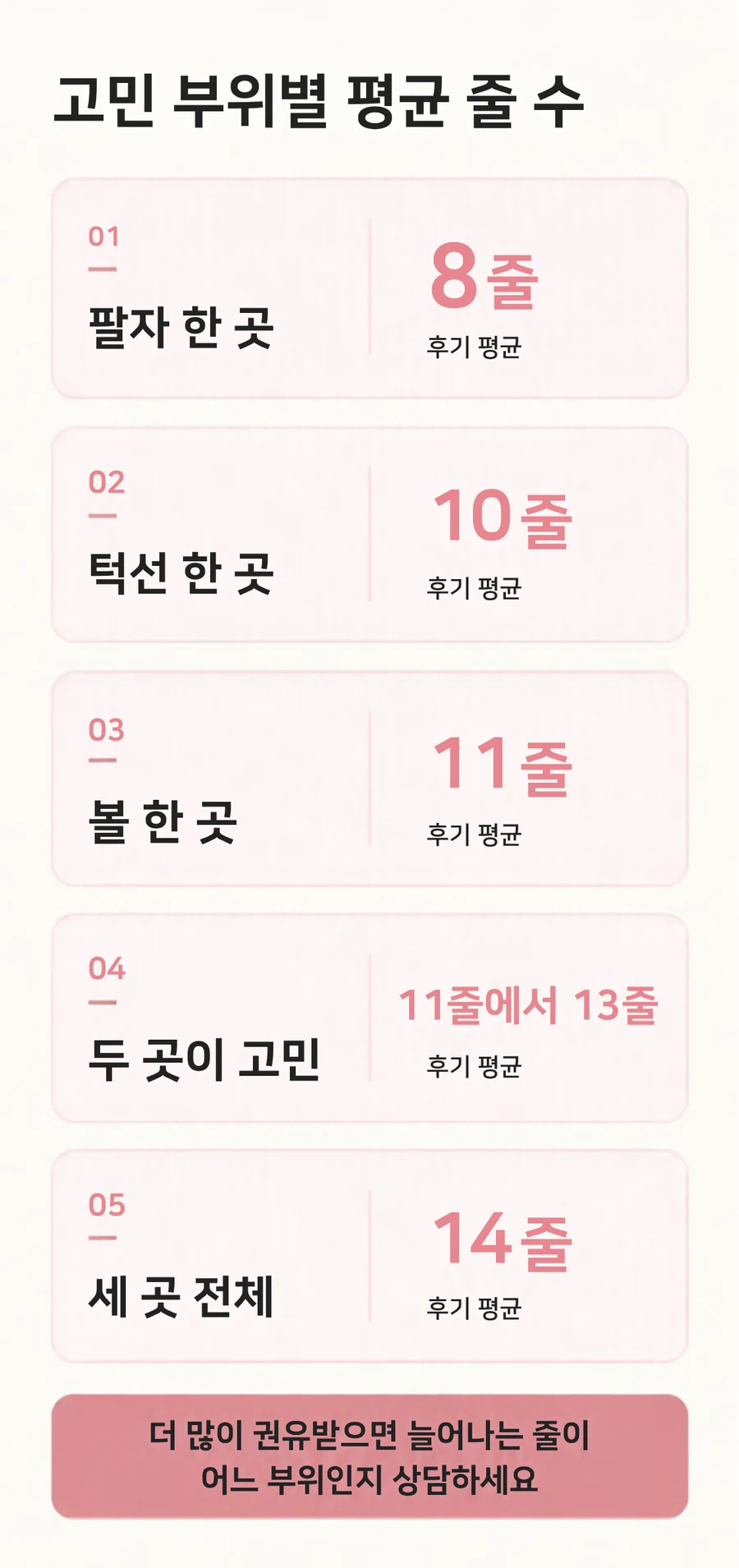
The overall average is about 11 thread, and the most common thread count is 8. Five counts (4, 6, 8, 10 and 12 threads) accounted for 73% of the total. The thread count is based on the total thread count written in the review, as the counting method varies depending on the clinic.
Does a higher thread count make a thread lift more effective?
In the reviews, the rate of effectiveness did not increase as the thread count increased. The regret rate and swelling period were as follows across the ranges.
| thread count | Proportion that the effect was good | Rate of regret | Swelling Average |
|---|---|---|---|
| 6 threads or less | 93% | 1.3% | 5 days |
| 7 threads to 8 threads | 91% | 1.9% | 6 days |
| 9 threads to 12 threads | 94% | 2.4% | 7 days |
| 13 threads or more | 91% | 5.2% | 10 days |
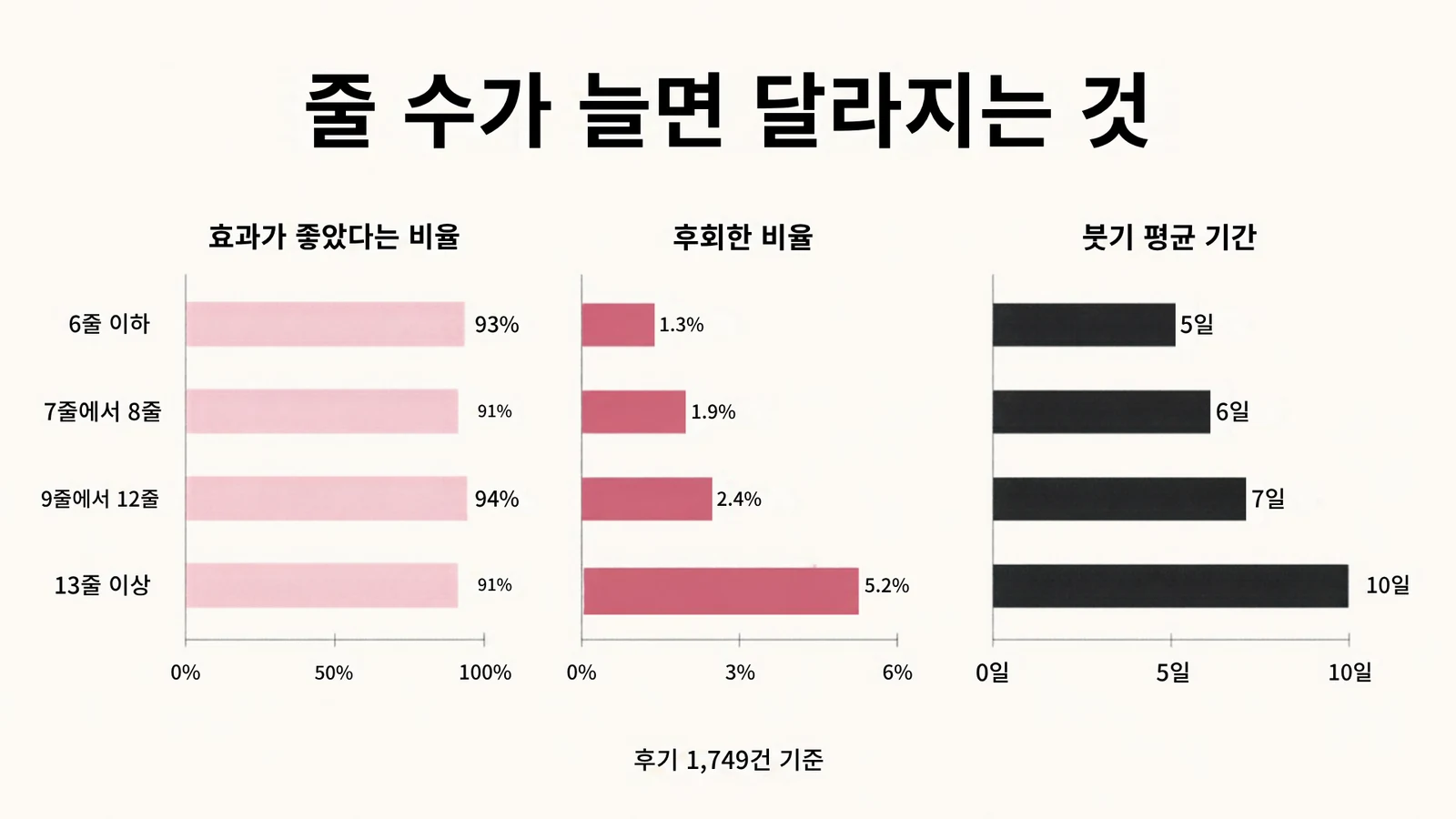
The regret rate for 13 threads or more was more than twice that for 12 threads or less. In a 2025 study that compared 3 and 6 PDO threads to each half of the face of 22 people, there was no difference in improvement between the two groups.
How should the thread type be chosen?
In the 2025 analysis, barbed threads had more side effects than smooth threads or cone-shaped threads, and polycaprolactone (PCL) material caused more swelling and bruising. This is based on an analysis of 19 studies, and in the review, MINT threads had the most.
| Thread type | Average thread count | Thread-count range |
|---|---|---|
| MINT threads | About 11 thread | 1 thread to 33 threads |
| JamBer threads | About 5 threads | 1 thread to 12 threads |
| Silhouette Soft | 6 threads | 2 threads to 16 threads |
| Cog series | About 11 thread | 4 threads to 20 threads |
| Multiple thread types | About 14 threads | 3 threads to 66 threads |
The average thread count received in reviews was different for each type, and the price also varies for each type, so the thread type and count should be decided during consultation.
What are the side effects of thread lift?
Common side effects are bruising, pain when chewing, and pulling, but serious side effects such as inflammation or thread removal are rare.
| bruise | Pain when chewing | pull | no effect | dimpling | Swelling persists |
|---|---|---|---|---|---|
| 5.3% | 5.2% | 4.0% | 2.8% | 2.5% | 1.6% |
| Palpable thread | Asymmetry | Short duration | Visible thread | Thread removal | Inflammation |
|---|---|---|---|---|---|
| 0.9% | 0.9% | 0.7% | 0.4% | 0.2% | 0.05% |
This is the percentage of people who wrote in their reviews that they experienced it themselves. In a 2021 analysis combining 26 studies, swelling was 35%, dimpling 10%, paresthesia 6%, threads seen or felt in 4%, and infection 2%. In the same analysis, people over 50 years were more likely to have dimpling (16% vs. 5.6%) and infections (5.9% vs. 0.7%).
When do people regret a thread lift?
The biggest reason for regret was that it was ineffective, followed by dimpling and touching the thread. There were two characteristics of people who regretted it.
- Among regret posts that stated a thread count, 46% involved 13 or more threads.
- Among those who had or planned to have a repeat procedure, less than 1% expressed regret.
These reasons came from 58 reviews that directly described regret. There are multiple reasons in one article, so the total is more than 58.
- Ineffective 35 cases
- Dimpling 15 cases
- 9 cases of a palpable thread
- 7 bruises
- 6 cases of pain when chewing
- 5 cases of prolonged swelling
- 5 asymmetries
- 5 cases of thread showing through
- In addition, 4 cases of short maintenance, 3 cases of pulling, 2 cases of thread removal, and 28 other cases.
How long can pain, swelling and bruising last after a thread lift?
85% of people said there was no pain or it was bearable, swelling occurred on average for 7 days, and bruising occurred in 52% of cases.
| Item | Results |
|---|---|
| pain | 57% said it barely hurt, 28% said it was bearable, 15% said it hurt a lot |
| anesthesia | sedation 64%, local anesthesia 34%, topical anesthetic cream 1% |
| Swelling Period | 50% for 3 days or less, 28% for 4 to 7 days, 15% for 8 to 14 days, 7% for more than 15 days |
| bruise | Yes 52%, No 48% |
In an analysis of 19 studies in 2025, the most common were bruising (19.5%), swelling (16.8%), and tenderness (10%).
How long will the thread lift effect last?
The average period of maintenance described in the reviews was about six months, and in three studies, the effect decreased between two months and one year. This is the distribution of the maintenance period written in the reviews.
| 3 months or less | 4 to 6 months | 7 to 12 months | 13 months or more |
|---|---|---|---|
| 49% | 22% | 20% | 8% |
The five studies reported the following:
- Combined analysis of 26 studies (2021): Satisfaction rate decreased from 98% immediately after the procedure to 88% six months later.
- Follow-up study of six people (2021): Midfacial volume improvement decreased from 5.59 mL at 120 days to 4.16 mL at approximately 350 days.
- Comparative study of 22 people (2025): Initial improvement in both 3 and 6 thread groups decreased around day 60, no difference even if double the amount of thread was used.
- Comparative study of 151 nasolabial folds (2026): 7-month response rate of 62.7% in control group with commercially available PDO thread
- Review of 12 studies involving 818 people (2025): Longest follow-up period: 2 years
Across the meta-analysis of 26 studies, the six-person follow-up and the 22-person comparison, In three studies, improvement was best immediately after the procedure and decreased between two months and a year. The remaining two studies only reported a 7-month response rate and the longest follow-up period.
How much does thread lift cost and what is it divided into?
MINT threads cost about 600,000 won on average for 8 threads, and the price per thread is about 110,000 won for 4 threads and about 80,000 won for 8 threads. This is the average of the sales prices posted by 55 Gangnam and Seocho clinics on Gangnam Unni and Babitalk.
| Thread type | Thread count | Clinics | Average listed price | Average per thread |
|---|---|---|---|---|
| MINT threads | 1 thread | 31 clinics | Approximately 90,000 won | Approximately 90,000 won |
| MINT threads | 4 threads | 8 clinics | Approximately 420,000 won | Approximately 110,000 won |
| MINT threads | 6 threads | 4 clinics | Approximately 600,000 won | Approximately 100,000 won |
| MINT threads | 8 threads | 10 clinics | Approximately 600,000 won | Approximately 80,000 won |
| MINT threads | 10 threads | 3 clinics | Approximately 690,000 won | Approximately 70,000 won |
| MINT threads | 12 threads | 4 clinics | Approximately 960,000 won | Approximately 80,000 won |
| JamBer threads | 4 threads | 5 clinics | Approximately 400,000 won | Approximately 100,000 won |
| Silhouette Soft | 4 threads | 7 clinics | Approximately 2.07 million won | Approximately 520,000 won |
- Price per thread: MINT threads are about 110,000 won for 4 threads, about 80,000 won for 8 threads, and about 70,000 won for 10 threads.
- Type of thread: Silhouette Soft costs approximately 520,000 won per thread, which is approximately 5 times the price of MINT threads 4 threads (approximately 110,000 won).
- Review payment amount: The average total payment amount for 82 reviews is approximately 1.63 million won, and the cost included for each post is different, so it cannot be directly compared to the sales price.
Even if the thread count is the same, the amount varies depending on the items below.
| Comparison criteria | What to check |
|---|---|
| Thread type | Mint, Jamber, Silhouette Soft, Cog |
| Unit | Is the product sold by thread, strand or cone, and what is the total thread count? |
| anesthesia | What is sedation, local anesthesia, or topical anesthetic cream and is it included in the cost? |
| VAT | Is VAT included in the displayed price? |
| Bundled treatment | Is Botox or a skin booster bundled with the treatment? |
| Pricing Terms | Are there any conditions for the event, first visit price, or Kakao channel? |
Most sales prices are event prices with terms and conditions, and the value-added tax notation varies depending on the clinic.
What should I ask during a thread lift consultation?
Rather than the thread count, you need to ask which areas the threads will be placed in. The same 12 threads are treated differently depending on whether they are driven into the cheeks or spread across the entire face.
| What to check | Questions to Ask |
|---|---|
| thread count by part | How many threads will be placed in the nasolabial folds, cheeks and jawline? |
| Thread type | What thread is it and why? |
| thread count basis | If more threads are recommended, which area will receive them? |
| anesthesia | Is it sedation or local anesthesia? Is the cost included? |
| If there are any side effects | What should I do if dimpling or a palpable thread occurs? |
| price | Is it per thread or total, and is VAT included? |
| Actual practitioner | Does the doctor I consult perform the procedure themselves? |
How DermaFocus compares clinics offering thread lifts
The recommendation guide applies the same four criteria to all clinics.
| Comparison Items | Verification criteria |
|---|---|
| Treatment information | Description of thread type, thread count by area, and whether or not information will be disclosed in case of side effects |
| medical staff | Specialist qualifications and actual practitioners confirmed by official sources |
| cost | Confirmation date, VAT, price conditions, whether anesthesia is included |
| Reviews | Repeated mention of sources, writing time, consultation and explanation for each platform |
Review counts and specialist credentials are not scores and do not guarantee treatment outcomes. The role of a recommendation guide is to display confirmed facts side by side using the same standards.
How this article was checked
The DermaFocus editorial team organized the reviews and research papers, and they were not supervised by medical professionals.
- Reviews: There are 2,866 thread lift (face) reviews by Gangnam Unni and Babitalk (as of October 1, 2026). There are 2,366 reviews with thread count and 500 reviews mentioning regret, dimpling, thread showing, inflammation, and removal.
- Analysis target: Among the 2,215 facial thread lift reviews, 1,955 have a thread count (including 1,749 with a clear total thread count). The side effect rate is based on 1,955 cases, and the reason for regret is based on 58 cases where regrets were written directly.
- Study: The evidence set includes six PubMed-indexed studies on absorbable thread lifts. There is one analysis combining 26 studies, two articles summarizing studies, two trials comparing randomly divided participants, and one study tracking six people.
- Price: This is the average of listed prices and 82 payments reported in Gangnam Unni and Babitalk reviews (including event prices) and payments written in reviews at 55 Gangnam and Seocho clinics as of October 1, 2026.
- Limitations: Most of the reviews were written immediately after the procedure. So most of the posts are satisfactory.
- Personal Information: The original text of the review, the author, and the name of the clinic are not included.
Frequently Asked Questions
What is the difference between 4, 8 and 12 threads in a thread lift?
The share of reviews covering only one treatment area was 4 threads 86%, 8 threads 70%, and 12 threads 59%, and the share covering two or more areas was 4 threads 14%, 8 threads 30%, and 12 threads 41%. Those who found it effective were 95% for 4 threads, 91% for 8 threads, and 93% for 12 threads, and those who regretted it were 1.4% for 4 threads, 2.0% for 8 threads, and 2.0% for 12 threads. The average swelling period was about 6 days for 8 threads and about 7 days for 12 threads.
Does thread lift really work?
Yes, 92% of people who reviewed the effect said they liked it. However, in study 3, improvement decreased between two months and one year after the procedure.
How does thread lift determine the type and number of threads?
In the review, if there was one problem area, the average was 8 threads to 11 thread, and if there were two areas, the average was 11 thread to 13 threads. Please determine the type of thread during consultation along with the thread count. In the 2025 analysis, barbed threads had more side effects than smooth threads.
Is thread lift more effective the higher the thread count is?
The proportion of sections with a high thread count was not higher, with 93% for 6 threads or less and 91% for 13 threads or more. It was 91% to 94% in each section, the regret rate was 2.0% for 12 threads or less and 5.2% for 13 threads or more, and the average swelling period was about 6 days for 8 threads, about 7 days for 12 threads, and about 10 days for 13 threads or more. Reviews alone cannot show whether thread count caused the difference. There was no difference in effectiveness in a study comparing 3 and 6 threads on each half of the face.
How long does thread lift last?
The average is about 6 months. In the study, the satisfaction rate dropped by 10 percentage points after 6 months, and the improvement in midface volume decreased between 120 and about 350 days.
What are the side effects of thread lift?
Bruising, pain when chewing, and pulling were the most common, and inflammation was rare. In the combined studies, swelling was the most common at 35%, dimpling at 10%, and infection at 2%. Dimpling and infection were more common in people over 50 years of age.
How long can swelling and bruising last after a thread lift?
Swelling lasts an average of 7 days, and half of it subsides within 3 days. Bruising occurred in 52%.
How much does thread lift cost?
The average selling price of MINT threads based on 8 threads is about 600,000 won, and the price per thread is about 110,000 won for 4 threads and about 80,000 won for 8 threads. The average payment amount listed in the reviews is about 1.63 million won, and even if the thread count is the same, it varies by clinic, so check whether it is the total amount or the amount per thread.
When do people regret a thread lift?
The most common case was that it felt ineffective, followed by dimpling or the thread being touched. The regret rate was high for over 13 threads.
How should a thread lift count be chosen?
In the reviews, the thread count differed depending on the number of areas of concern, and the rate of good effectiveness was 91% to 94% across thread-count ranges. In consultation, rather than the thread count, ask first which areas the threads will be placed in, what anesthesia is, and what to do if side effects occur.
Sources and verification dates
- Niu Z et al. Facial thread lift complication rate meta-analysis, Aesthetic Plast Surg 2021 (PMID 33821308)(confirmed 2026-10-01): 26 studies, swelling 35%, dimpling 10%, paresthesia 6%, thread visible or palpable 4%, infection 2%, dimpling and infection in those over 50 years old, satisfaction decreased from 98% to 88%
- Ojha AS et al. Comparison of side effects by absorbable thread lift material, Dermatol Surg 2025 (PMID 39442180)(confirmed 2026-10-01): 19 studies, 1,406 people, bruising 19.49%, swelling 16.79%, tenderness 9.96%, Side effects of barbed thread and PCL material
- Riopelle AM et al. Absorbable facial thread lift latest summary, Dermatol Surg 2025 (PMID 39662017)(confirmed 2026-10-01): 12 articles, 818 patients, longest follow-up 2 years
- Germani M et al. Randomized comparative trial by number of PDO threads, Aesthet Surg J Open Forum 2025 (PMID 40236886)(confirmed 2026-10-01): 22 patients, 3 vs. 6 half-face threads, improvement decreased around day 60, no difference between the two groups.
- Diaspro A et al. Mid-face thread lift quantitative evaluation pilot study, Dermatol Ther 2021 (PMID 33840127)(confirmed 2026-10-01): 6 patients, volume improvement 5.59 mL for 120 days, 4.16 mL for approximately 350 days
- Jia D et al. Nasolabial folds absorbable thread multicenter randomized trial, Aesthetic Plast Surg 2026 (PMID 42380313)(confirmed 2026-10-01): 151 patients, 7-month response rate with commercially available PDO thread control group 62.7%
- Gangnam Unni review and Babitalk review (platform review, confirmed on 2026-10-01): Based on 2,866 thread lift (face) reviews. The original text of the review is not included.
- Gangnam Unni and Babitalk clinic listed prices (confirmed on 2026-10-01): Sales prices by thread count for 55 Gangnam and Seocho clinics, mixed VAT notation, clinic names not included
Editorial responsibility and relationships
DermaFocus has no advertising, contract, or affiliation with any of the hospitals or manufacturers mentioned in this article, and has not received any money or sponsorship. This article is a compilation of information needed to select a procedure and does not replace a personal diagnosis or treatment plan.